An Algorithmic Framework for Bangladesh
Author: Abdulla Al Babul, Researcher & Writer | AI, Future of Work, Technology, Sustainable Manufacturing, and Society
Framework: Workplace Conduct Optimization Matrix (WCOM)
Date: September 2024
Executive Summary
Misconduct is one the most pressing challenges facing both manufacturing and services organizations in Bangladesh.
Misconduct can be ethical, financial, sexual, or behavioral – and when left unmanaged, it damages organizational culture, reduces productivity, drives away talent, and undermines ROI and brand reputation.
The WCOM Solution Design offers a scientific, algorithm-based SOP for managing misconduct through structured escalation:
- PLM – Primary Level Misconduct
- ILM – Intermediate Level Misconduct
- UILM – Upper Intermediate Level Misconduct
- ALM – Advanced Level Misconduct
By applying this structured algorithm, organizations can achieve fairness, transparency, and accountability, ensuring both employees and employers benefit from a positive, bias-free work environment.
Defining Misconduct
Misconduct is defined as bad, improper, or illegal behavior, particularly when committed by individuals in a position of responsibility. Common categories include:
- Ethical Misconduct – dishonesty, favoritism, conflict of interest.
- Financial Misconduct – embezzlement, fraud, unauthorized transactions.
- Sexual Misconduct – harassment, exploitation, inappropriate advances.
- Employee / Executive Misconduct – absenteeism, insubordination, workplace violence, abuse of authority.
Misconduct List based on Bangladesh Labor Law:
- Willful insubordination or disobedience, weather alone or in combination with others to any lawful or reasonable order of a superior.
- Theft, fraud, or dishonesty in connection with the employer’s business or property.
- Taking for giving bribe in connection with his or any other workers’ employment under the employer.
- Habitual late attendance
- Habitual breach of any law or rule or regulation applicable to the establishment
- Habitual breach of any law or rule or regulation applicable to the establishment
- Riotous or disorderly behavior in the establishment, or any act subversive of discipline
- Habitual negligence work
- Habitual breach of any rule of employment, including conduct or discipline, approved by the chief inspector.
- Falsifying, tempering with, damaging or causing loss of employer’s official records.
Business Impact of Misconduct
On Employees:
- Indiscipline and absenteeism
- Formal case filings and career risk
- Loss of reputation within organization
- Resignation or permanent exit
On Employers:
- Unhealthy and hostile work environment
- Decline in quality and delayed production
- Loss of talented professionals
- Fall in ROI and productivity
- Weakening of brand image in competitive markets
Algorithmic Solution: Workplace Conduct Optimization Matrix
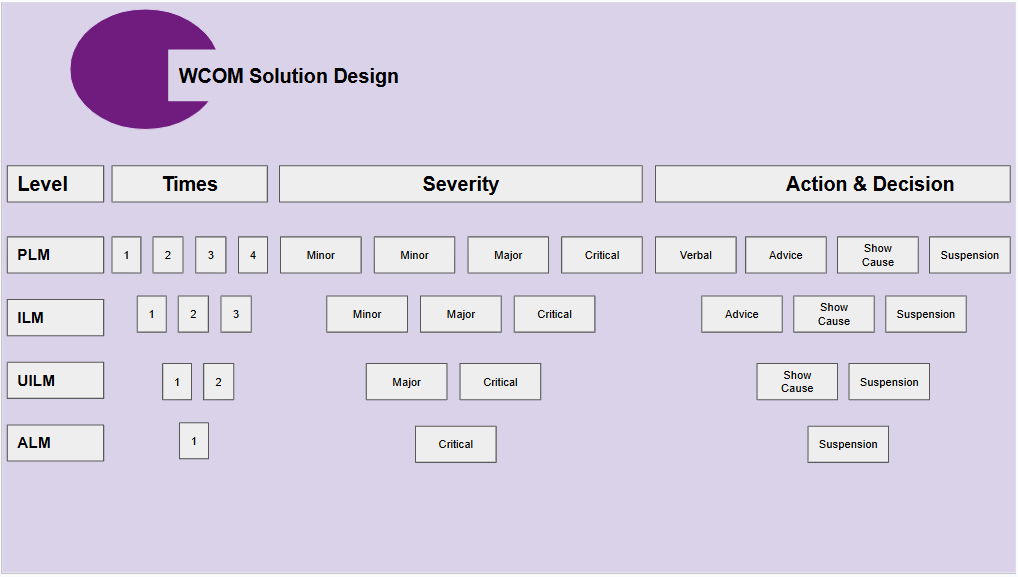
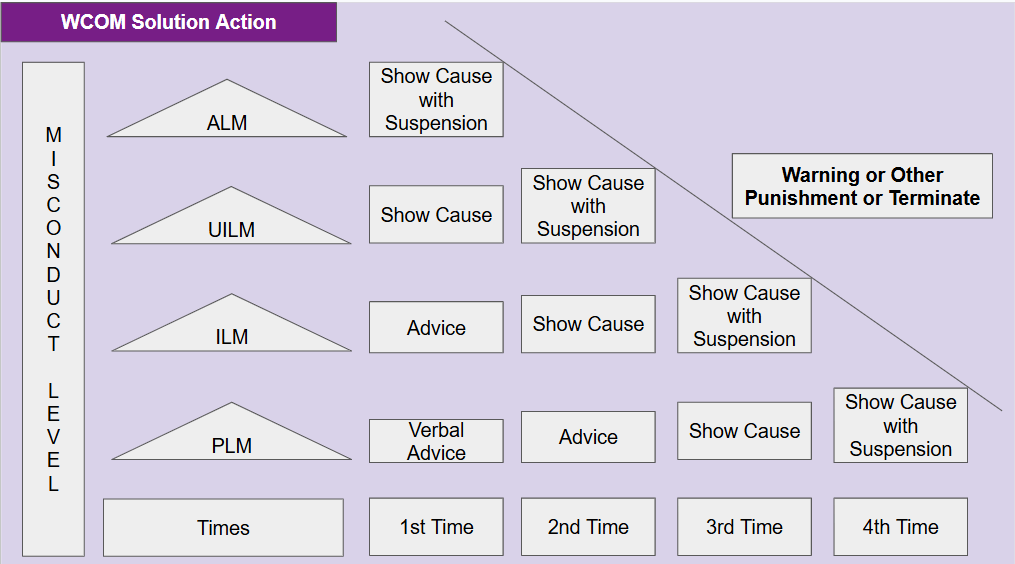
The WCOM Solution Design applies an escalation algorithm based on frequency and severity of misconduct. Each case is categorized into one of four levels, ensuring consistent, fair, and proportional decisions.
1. PLM – Primary Level Misconduct
- Times: 1st → 2nd → 3rd → 4th instance.
- Severity: Minor → Minor → Major → Critical.
- Action & Decision:
- 1st Time: Verbal Warning.
- 2nd Time: Advice and coaching.
- 3rd Time: Show cause letter
- 4th Time: Suspension
Purpose: Correct behavior early before it escalates.
2. ILM – Intermediate Level Misconduct
- Times: 1st → 2nd → 3rd instance.
- Severity: Minor → Major → Critical.
- Action & Decision:
- 1st Time: Advice.
- 2nd Time: Show Cause letter.
- 3rd Time: Suspension.
Purpose: Handle repeated or higher-level misconduct with stricter steps.
3. UILM – Upper Intermediate Level Misconduct
- Times: 1st → 2nd instance.
- Severity: Major → Critical
- Action & Decision:
- 1st Time: Show Cause notice
- 2nd Time: Suspension
Purpose: Address serious violations promptly, with limited tolerance for repeat behavior.
4. ALM – Advanced Level Misconduct
- Times: 1st instance only.
- Severity: Critical misconduct (fraud, violence, sexual harassment, corruption).
- Action & Decision:
- Immediate Suspension with possible termination and legal escalation.
Purpose: Protect organization instantly from high-risk misconduct.
Key Features of the Algorithm
- Progressive Discipline: Minor misconduct is corrected with verbal or written guidance before suspension.
- Severity-Based Logic: Critical violations are addressed immediately.
- Fairness & Consistency: Removes bias and favoritism in disciplinary actions.
- Prevention-Oriented: Early warnings and advice encourage self-correction.
- Legal Protection: Each stage (verbal → advice → show cause → suspension) is documented, reducing risks of wrongful dismissal claims.
Application Across Industries
Manufacturing Industry:
- Garments, Textiles, Spinning, Printing
- FMCG, Pharmaceutical, Leather, Footwear
- Ceramics, Steel, Furniture, Electronics, Automobiles
Service Organizations:
- Banks & Financial Institutions
- Telecommunication & Mobile Network Operators
- Hospitals, Clinics, Diagnostics
- Hotels, Motels, Resorts
- Buying Offices & Service Providers.
Practical Example: Garments Sector
- Case 1: Absenteeism (PLM)
- 1st Time: Verbal warning.
- 2nd Time: Advice.
- 3rd Time: Show cause.
- 4th Time: Suspension.
- Case 2: Theft (ALM)
- 1st Instance: Immediate Suspension + legal process
Business Value of WCOM Solution Design
- Employee Side: Ensures fairness, prevents career loss from small mistakes, provides structured chances for correction.
- Employer Side: Protects ROI, brand reputation, and production quality.
- Industry Side: Enhances compliance and buyer confidence in Bangladesh.
- Societal Side: Builds transparent, ethical and safe workplaces.
Role of HR & Third-Party Consultants
If in-house HR teams struggle to manage misconduct, independent HR consultants should be engaged to:
- Review current policies
- Customize misconduct SOPs
- Train managers in algorithmic decision-making
- Ensure cultural and legal alignment
Conclusion
Misconduct is not only a matter of discipline – it is a strategic business issue. The WCOM Solution Design provides a scientific, step-by-step algorithm that transforms misconduct management into a transparent, fair, and result-oriented system.
By applying this framework, organizations in Bangladesh can:
- Protect their investments.
- Retain and develop talent.
- Maintain compliance and brand image.
- Build healthier and more sustainable workplaces.
This white paper is developed by Abdulla Al Babul, based 15+ years of HR practices, analyzing misconduct, grievance, and disciplinary cases across in Bangladesh.
** WCOM Solution Design
** WCOM Scoring Framework
Severity Scoring Table
| Score | Severity Level | Description | Typical Examples (Garments & Service Industry) |
|---|---|---|---|
| 1 – 4 | Primary Level (PLM) | Low-level misconduct that causes minimal disruption. Often first-time or occasional cases. | Late attendance, minor negligence, improper dress code, using phone during work. |
| 5 – 7 | Intermediate Level (ILM) | Misconduct that affects productivity or discipline. Repeated primary misconduct escalates here. | Ignoring supervisor’s instruction, misuse of company property, repeated absenteeism, non-compliance with SOP. |
| 8 – 9 | Upper Intermediate Level (UILM) | Serious misconduct with higher impact on workplace safety, ethics, or team harmony. | Harassment, verbal abuse, falsifying records, ignoring safety protocols, gross insubordination. |
| 10 | Advanced Level (ALM) | Critical misconduct with severe consequences. May result in immediate suspension/termination as per law. | Theft, violence, fraud, bribery, physical harassment, sabotage. |
How to Use the Score
- Assign a score when misconduct is reported (based on severity).
- Track cumulative scores for repeat offenders.
- Example: Two PLMs (score 1 each) = ILM level action.
- Apply WCOM Matrix Actions:
- 1–4 (PLM) → Verbal → Advice → Show Cause → Suspension.
- 5–7 (ILM) → Advice → Show Cause → Suspension.
- 8–9 (UILM) → Show Cause → Suspension.
- 10 (ALM) → Direct Suspension/Dismissal.
- Document and review for fairness and compliance with Bangladesh Labour Law.
Benefits of Adding Scores:
- Quantifies misconduct in numbers → easy for HR dashboards & audits.
- Helps in trend analysis (e.g., most common misconduct type & severity).
- Provides a transparent system for both management and employees.
- Makes misconduct management data-driven & buyer-compliant.


Leave a Reply