The BOAT Model™
An Integrative Framework for Decision Effectiveness and Organizational Performance
Abdulla Al Babul
Researcher and Writer | AI, Future of Work, Technology, Sustainable Manufacturing, and Society
Consult Broadly. Analyze Objectively. Decide Clearly. Execute Rapidly.
Abstract
Organizations increasingly operate in environments characterized by complexity, uncertainty, information overload, and competing stakeholder interests. While participative management encourages diverse viewpoints, excessive consultation without structured decision mechanisms often leads to decision paralysis, delayed execution, diminished accountability, and reduced organizational effectiveness. This paper introduces the BOAT Model™, an integrative organizational framework designed to enhance decision quality and execution effectiveness through four interconnected dimensions: Broad Consultation, Objective Analysis, Authority to Decide, and Timely Execution.
The model proposes that organizational success depends not merely on the quantity of ideas generated but on the organization’s ability to transform collective intelligence into focused action. Drawing upon theories of participative decision-making, evidence-based management, decision-rights governance, accountability systems, and execution management, the BOAT Model™ offers a practical and measurable approach for leaders seeking to improve organizational agility, strategic alignment, and performance outcomes.
Keywords: Decision-Making, Organizational Development, Leadership, Evidence-Based Management, Accountability, Execution Excellence, Change Management.
Introduction
Across industries and sectors, organizations frequently encounter a paradox. Leaders are encouraged to seek diverse perspectives, promote collaboration, and involve stakeholders in decision-making processes. Yet many organizations discover that greater participation does not automatically produce better decisions.
Instead, organizations often experience:
- Endless meetings without outcomes.
- Conflicting recommendations.
- Delayed project implementation.
- Ambiguous accountability.
- Reduced organizational agility.
- Strategic drift.
This phenomenon may be summarized by the proverb:
“Too many opinions sink the boat.”
The proverb does not argue against diversity of thought. Rather, it highlights the dangers of unmanaged participation in the absence of structured decision processes. Organizations require multiple perspectives to identify risks and opportunities, but they also require mechanisms that transform discussion into action.
The BOAT Model™ was developed as a response to this challenge. Figure 1 contrasts the failure mode of unmanaged participation with the structured process the model prescribes, and previews its four dimensions.
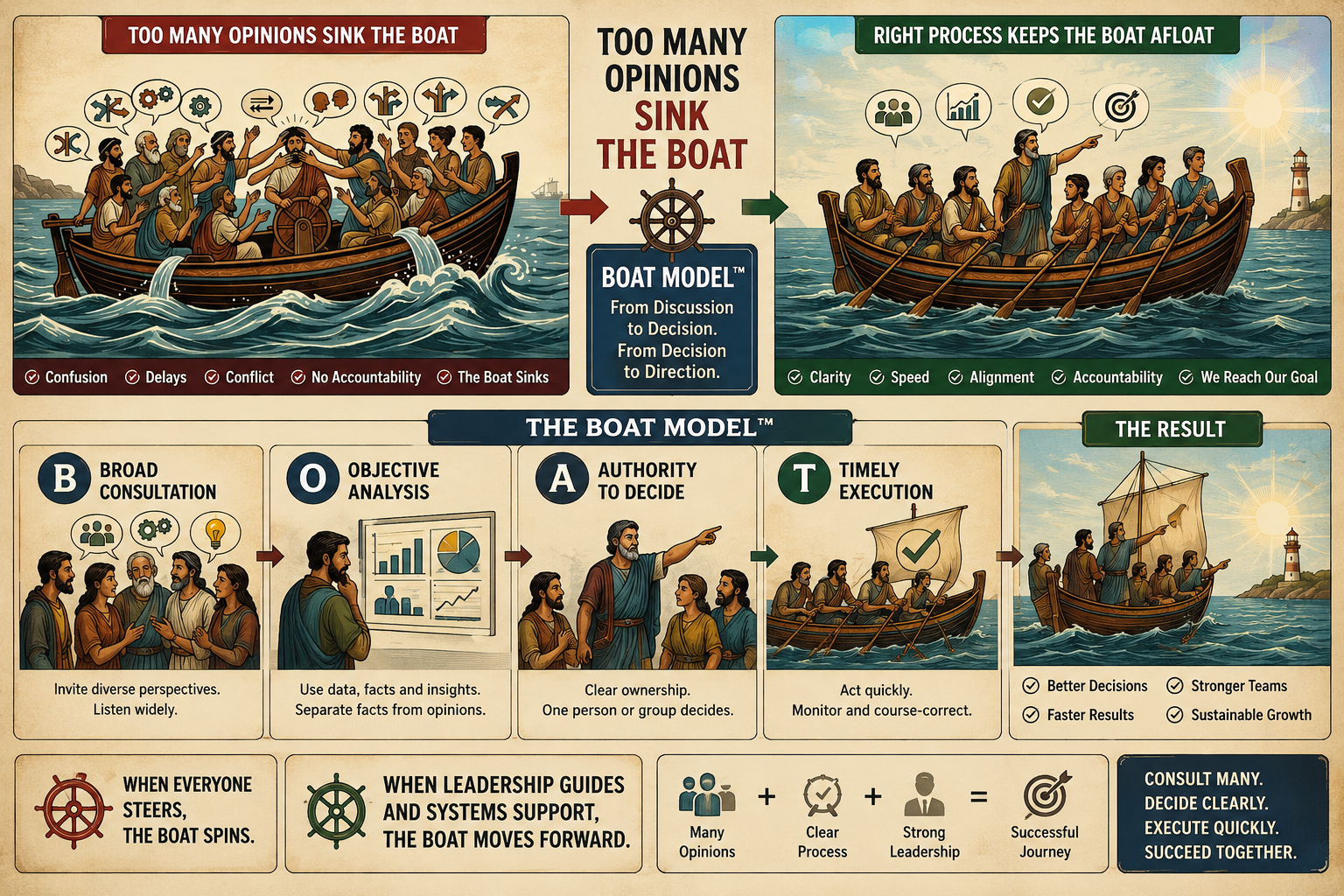
Theoretical Foundation
The BOAT Model™ integrates concepts from several established academic traditions.
Participative Decision-Making
Research consistently demonstrates that involving stakeholders improves information quality, enhances commitment, and strengthens organizational learning. However, participation becomes counterproductive when consultation lacks clear boundaries.
Evidence-Based Management
Evidence-based management emphasizes the use of data, analytics, and empirical evidence rather than assumptions or personal preferences. Organizations that systematically use evidence tend to make more effective strategic decisions.
Decision Rights Theory
Decision rights theory suggests that organizational effectiveness improves when authority and accountability are clearly assigned. Ambiguity regarding who possesses decision authority often creates delays and conflicts.
Execution Management
Execution research highlights that organizational success depends not only on choosing the correct strategy but also on implementing that strategy effectively and rapidly.
The BOAT Model™ synthesizes these perspectives into a unified framework for organizational decision effectiveness.
The BOAT Model™
The BOAT Model™ consists of four sequential and interdependent dimensions.
B – Broad Consultation
Broad Consultation refers to the systematic collection of diverse perspectives from relevant stakeholders before major decisions are made.
The objective is not consensus. The objective is information quality.
Organizations operating in complex environments require insights from employees, customers, technical experts, managers, and external stakeholders. Diverse perspectives help leaders identify hidden risks, alternative solutions, and emerging opportunities.
However, consultation must remain purposeful. Excessive consultation may generate confusion, political bargaining, and analysis paralysis.
Core Question. Have we heard from the people who possess relevant knowledge?
O – Objective Analysis
Consultation generates information. Objective Analysis transforms information into evidence.
This stage requires organizations to evaluate facts, data, performance indicators, strategic implications, and risks. Objective Analysis protects decision-making processes from cognitive biases, personal preferences, hierarchy effects, and organizational politics.
Organizations frequently fail not because information is unavailable, but because information is ignored.
Core Question. What does the evidence actually suggest?
A – Authority to Decide
Authority to Decide represents the governance dimension of the BOAT Model™.
Many organizations suffer from decision diffusion, a condition in which multiple individuals influence decisions while no individual accepts responsibility for them.
Effective organizations distinguish clearly between:
- Contributors.
- Advisors.
- Reviewers.
- Decision-makers.
The BOAT Model™ asserts that consultation should be broad, but decision authority should be explicit.
Core Question. Who owns the final decision and its consequences?
T – Timely Execution
Timely Execution converts decisions into measurable outcomes.
A decision possesses little organizational value unless it produces action. Organizations that execute rapidly often outperform competitors with superior strategies but slower implementation processes.
Timely Execution involves:
- Action planning.
- Resource allocation.
- Monitoring systems.
- Feedback loops.
- Continuous improvement.
Execution transforms strategic intent into organizational performance.
Core Question. How quickly can we move from decision to action?
The BOAT Principle
The central proposition of the BOAT Model™ may be expressed as follows:
Organizational effectiveness increases when broad consultation is combined with objective analysis, clear decision authority, and timely execution.
Conversely, organizational effectiveness decreases when consultation expands without corresponding structures for analysis, accountability, and implementation.
Organizational Applications
The BOAT Model™ may be applied across multiple organizational domains.
Strategic Planning
Ensures stakeholder input while maintaining executive accountability.
Human Resource Management
Supports workforce planning, succession management, performance management, and employee engagement initiatives.
Change Management
Balances employee participation with leadership direction during transformation programs.
Project Management
Improves decision speed and reduces project delays.
Crisis Leadership
Provides a framework for rapid and accountable decision-making under uncertainty.
Implications for Organizational Development
The BOAT Model™ contributes to organizational development by addressing a persistent challenge within modern institutions: the gap between participation and execution.
Organizations often possess abundant intelligence but insufficient mechanisms for converting intelligence into coordinated action.
The BOAT framework offers a practical solution by ensuring that consultation enriches decision quality while authority and execution sustain organizational momentum.
As organizations face increasing complexity, competitive pressure, and technological disruption, decision effectiveness may become one of the most important organizational capabilities of the twenty-first century.
Conclusion
The future belongs not to organizations with the greatest number of opinions, but to organizations capable of transforming diverse perspectives into decisive action.
The BOAT Model™ provides a structured pathway for achieving this objective through Broad Consultation, Objective Analysis, Authority to Decide, and Timely Execution.
Together, these dimensions create a balanced system that promotes inclusion without paralysis, analysis without delay, authority without authoritarianism, and execution without confusion.
In an era defined by uncertainty and complexity, the BOAT Model™ offers leaders a practical framework for navigating organizational challenges and moving confidently toward sustainable performance and long-term success.
Consult Broadly. Analyze Objectively. Decide Clearly. Execute Rapidly.


Leave a Reply