Abdulla Al Babul
Researcher & Writer | AI, Future of Work, Technology, Sustainable Manufacturing, and Society
“Performance is not a snapshot — it is an ecology. Dynamic, relational, and sustainable.”
Abstract
Job performance has traditionally been conceptualized as a multidimensional construct of individual behavior linked to organizational outcomes. While foundational, existing frameworks remain insufficient for dynamic, AI-enabled work environments characterized by continuous algorithmic feedback, socio-technical interdependence, and long-term sustainability imperatives. This article introduces Adaptive Performance Ecology (APE) Theory, a system-level framework that reconceptualizes performance as an adaptive, emergent phenomenon arising from sustained interactions among individuals, technologies, and feedback systems over time.
The theory proposes five interdependent performance domains — Task Execution, Adaptive–Cognitive, Relational–System, Ethical–Regulatory, and Energy & Sustainability Performance — and formalizes their relationships through a dynamic systems model. A new applied extension, the APE Promotion Readiness Framework, maps APE domain profiles onto a competency-based six-level career architecture, deriving principled promotion gate criteria for each band transition.
Keywords: job performance; adaptive systems; AI in organizations; workforce analytics; sustainability; socio-technical systems; dynamic systems modeling; career architecture; promotion readiness
1. Introduction
Job performance is one of the most consequential constructs in organizational science, linking individual behavior to organizational effectiveness, competitive advantage, and workforce sustainability. Foundational scholarship established that performance is inherently multidimensional, extending well beyond narrow output measures to encompass task proficiency, interpersonal contributions, and organizational citizenship (Campbell, 1990; Borman & Motowidlo, 1997).
Yet the organizational environments for which these models were developed have changed fundamentally. Modern workplaces are increasingly characterized by AI-mediated task allocation, real-time algorithmic performance monitoring, distributed and hybrid collaboration structures, and escalating demands for ethical governance and workforce sustainability (Brynjolfsson & McAfee, 2014). In these environments, performance is not a stable attribute measured periodically; it is a continuously evolving, system-embedded process shaped by feedback loops, technological augmentation, and shifting relational contexts.
This paper responds to that gap by introducing Adaptive Performance Ecology (APE) Theory. A new applied extension — the APE Theory Promotion Readiness Framework — is presented in Section 8, mapping APE domain profiles onto a competency-based career architecture across six organizational levels.
2. Theoretical Background
2.1 Multidimensional Models of Job Performance
Campbell’s (1990) hierarchical model identified eight latent performance components, arguing that performance must be understood as behavior rather than outcome. Borman and Motowidlo’s (1997) influential distinction between task performance and contextual performance further expanded the construct’s scope. Pulakos et al. (2000) subsequently introduced adaptive performance as a critical dimension, capturing the capacity to respond effectively to novel, uncertain, or rapidly changing task demands.
Despite these advances, existing multidimensional models share a common limitation: they conceptualize performance domains as relatively stable, additive, and individual-centric. Interactions among domains, feedback-driven evolution over time, and the role of technological systems remain largely theorized rather than formally modeled.
2.2 Socio-Technical and Dynamic Systems Perspectives
Socio-technical systems (STS) theory asserts that organizational performance is an emergent property of the joint optimization of social and technical subsystems (Trist & Bamforth, 1951). Dynamic systems theory provides a further theoretical resource by emphasizing nonlinearity, feedback, path dependence, and adaptive self-organization as central features of complex systems (Sterman, 2000).
2.3 AI-Enabled Work and Emerging Performance Demands
The rapid diffusion of AI and data-intensive technologies introduces qualitatively new performance demands. Algorithmic performance monitoring creates continuous, granular feedback environments. Human–AI collaboration requires adaptive cognitive engagement beyond traditional task proficiency. Ethical and regulatory considerations — fairness in algorithmic decision-making, data privacy, and accountability — are increasingly constitutive of what it means to perform well.
2.4 Identified Gaps
Three persistent limitations motivate the development of APE Theory:
- The absence of dynamic, longitudinal modeling in prevailing performance frameworks, which treat performance as a snapshot rather than an evolving trajectory.
- Limited integration of AI systems, algorithmic feedback, and human–technology interaction as constitutive dimensions of performance.
- The neglect of ethical–regulatory behavior and long-term energy sustainability as core performance domains.
3. Adaptive Performance Ecology (APE) Theory
3.1 Core Definition and Foundational Principles
APE Theory defines job performance as:
An adaptive and emergent pattern of behavior arising from continuous interactions among individuals, socio-technical systems, and feedback mechanisms — including algorithmic, managerial, and peer feedback — as these unfold across time and organizational context.
This definition reflects three foundational principles. Performance is inherently relational: it cannot be understood in isolation from the socio-technical environment. Performance is temporally dynamic: it evolves through recursive feedback processes. Performance is ecologically constrained: it operates within boundaries set by ethical-regulatory requirements and the sustainable capacities of human agents.
3.2 The Five Performance Domains
APE Theory proposes five interdependent domains that together constitute the full ecology of job performance. These domains are neither additive nor independent; they interact dynamically, and change in one domain propagates across others through feedback mechanisms.
Table 1. APE Theory Performance Domains
| Performance Domain | Symbol | Key Indicators | Hypothesis |
|---|---|---|---|
| Task Execution Performance | T | Efficiency, quality, accuracy, throughput | H1 |
| Adaptive–Cognitive Performance | A | Learning agility, AI tool utilization, problem-solving | H2 |
| Relational–System Performance | R | Coordination, collaboration, network centrality | H3 |
| Ethical–Regulatory Performance | E | Compliance, fairness, transparency, accountability | H4 |
| Energy & Sustainability Performance | S | Workload capacity, well-being, burnout resistance | H5 |
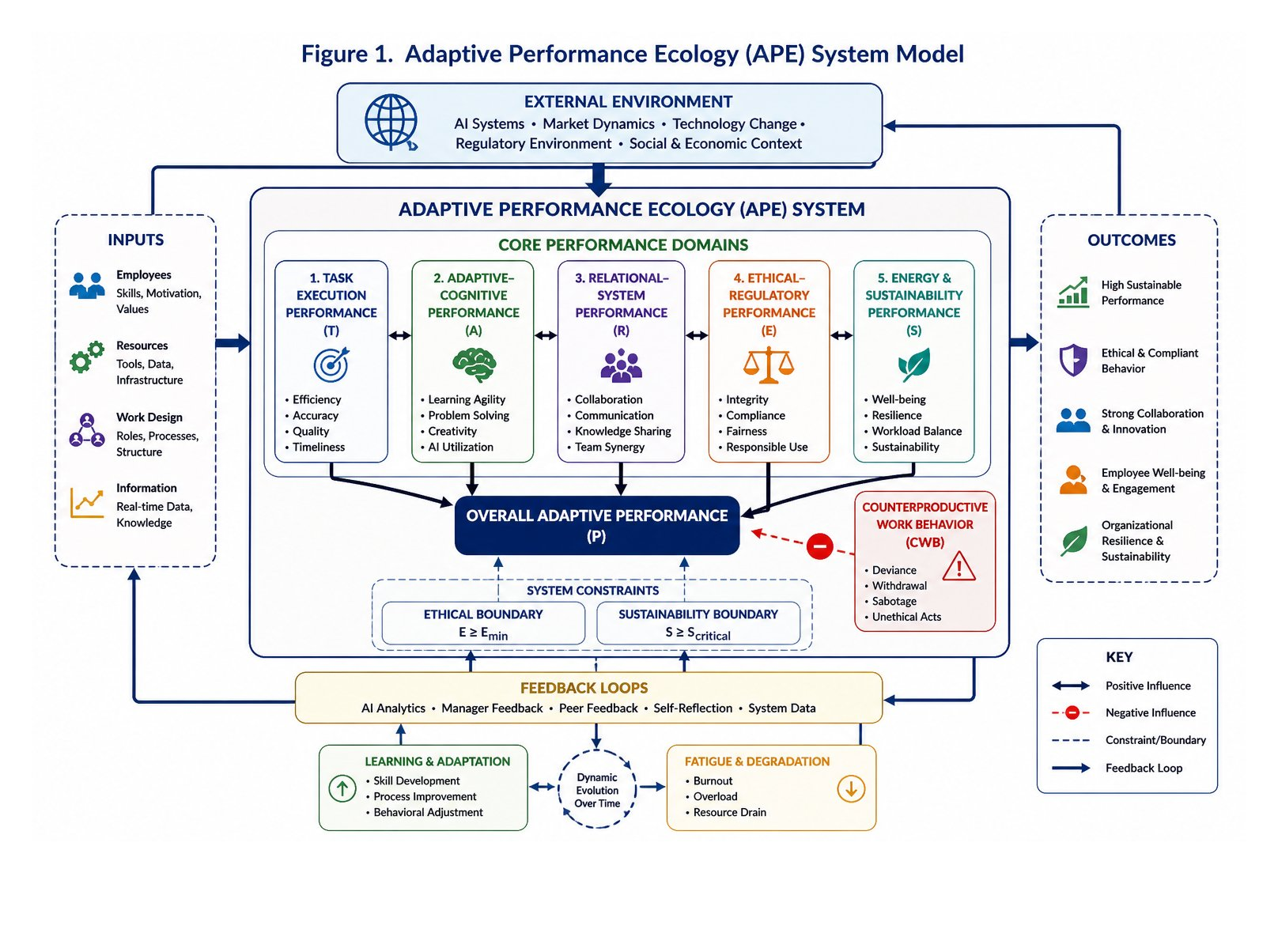
Figure 1. The APE System Model. Five core performance domains (T, A, R, E, S) jointly determine Overall Adaptive Performance (P). Ethical and sustainability boundaries define the viable performance space. CWB emerges endogenously when relational, ethical, and sustainability conditions deteriorate.
3.2.1 Task Execution Performance (T)
Task Execution Performance refers to the proficiency, efficiency, and accuracy with which an individual fulfills the formally defined requirements of their role. It is reconceptualized as a dynamic output variable responsive to feedback and resource availability (Borman & Motowidlo, 1997).
3.2.2 Adaptive–Cognitive Performance (A)
Adaptive–Cognitive Performance captures an individual’s capacity to acquire new competencies, apply generative problem-solving in non-routine situations, and effectively leverage AI and digital tools. This domain extends Pulakos et al.’s (2000) adaptive performance construct by explicitly incorporating human–AI collaboration as a constitutive behavioral dimension.
3.2.3 Relational–System Performance (R)
Relational–System Performance encompasses an individual’s contribution to collective coordination, cross-functional collaboration, and productive network relationships. Drawing on STS theory (Trist & Bamforth, 1951), this domain treats relational behavior as a structural element of the performance system.
3.2.4 Ethical–Regulatory Performance (E)
Ethical–Regulatory Performance refers to the degree to which behavior is consistent with organizational compliance requirements, professional ethical standards, and principles of fairness and accountability — including those arising from the governance of AI systems.
3.2.5 Energy & Sustainability Performance (S)
Energy & Sustainability Performance captures an individual’s ability to maintain productive engagement over time without unsustainable depletion of personal resources, integrating concepts from conservation of resources theory (Hobfoll, 1989).
4. Formal Dynamic Model
4.1 Static Performance Function
At any time point t, overall performance P is formally represented as:
Eq. 1 P(t) = f(Tₙ, Aₙ, Rₙ, Eₙ, Sₙ) − λ · Cₙ
Cₙ = CWB magnitude at time t; λ = decay coefficient weighting the behavioral penalty against aggregate domain performance
4.2 Dynamic Evolution Equation
APE Theory formalizes performance as a trajectory rather than a state:
Eq. 2 P(t+1) = P(t) + α · Lₙ − γ · Fₙ + δ · FBₙ
Lₙ = net learning; Fₙ = fatigue/resource depletion; FBₙ = net feedback signal; α, γ, δ = domain-calibrated sensitivity coefficients
4.3 CWB Emergence Function
CWB is modeled as an endogenously generated signal of system stress:
Eq. 3 C(t) = g(Rₙ, Eₙ, Sₙ) | ∂C/∂R < 0, ∂C/∂E < 0, ∂C/∂S < 0
CWB increases as relational, ethical, and sustainability performance deteriorates — consistent with conservation of resources theory (Hobfoll, 1989)
5. Hypothesis Development
Six testable hypotheses are derived from APE Theory, addressing predictive superiority, individual domain contributions, and CWB dynamics.
6. Proposed Empirical Methodology
6.1 Research Design
Validation of APE Theory requires a mixed-method, multi-level longitudinal design integrating: Q-methodology to identify systematic variation in worker performance system perspectives; longitudinal panel survey and behavioral data collection to operationalize domain scores; and machine learning modeling to estimate predictive validity and identify interaction effects.
6.2 Data Sources
- Organizational KPI and performance management records (Task Execution Performance)
- Learning management system records and AI tool usage logs (Adaptive–Cognitive Performance)
- Organizational network analysis and collaboration platform data (Relational–System Performance)
- Compliance, ethics, and audit system records (Ethical–Regulatory Performance)
- Employee well-being surveys, workload assessments, and absenteeism records (Energy & Sustainability Performance)
- Validated behavioral indicators and peer-report measures of counterproductive work behavior
6.3 Analytical Strategy
- CFA and SEM: to test discriminant and convergent validity of the five APE domains and evaluate structural hypotheses (H1–H5)
- Moderated regression and MLM: to estimate cross-level and interaction effects
- Machine learning (Random Forest, XGBoost, LSTM): to evaluate predictive validity against KPI-only benchmarks
- Time-series modeling and VAR: to estimate dynamic feedback relationships consistent with Equation 2
- Organizational network analysis (ONA): to operationalize Relational–System Performance
7. Theoretical and Practical Contributions
7.1 Theoretical Contributions
APE Theory makes three principal contributions. First, it provides the first formally specified dynamic systems model of job performance integrating feedback, learning, fatigue, and CWB emergence within a single mathematical framework. Second, APE Theory is the first performance framework to treat AI-enabled behaviors, ethical-regulatory conduct, and long-term sustainability as constitutive performance domains. Third, by bridging socio-technical systems theory, dynamic systems thinking, and computational workforce analytics, APE Theory offers a conceptual foundation for performance research commensurate with contemporary organizational complexity.
7.2 Methodological Contributions
The proposed empirical methodology advances performance science by combining Q-methodology with longitudinal panel designs and machine learning validation. The machine learning validation approach enables direct benchmarking of APE against KPI-only models, providing an empirical basis for evaluating the practical value of the expanded framework.
7.3 Practical Contributions
For practitioners, APE Theory supports the design of more equitable, sustainable, and effective performance management systems. The dynamic model provides a conceptual scaffold for real-time, AI-driven performance monitoring systems that can detect early warning signals of performance deterioration and trigger targeted interventions before crises develop.
8. APE Theory — Promotion Readiness Framework
8.1 Rationale and Conceptual Basis
Traditional career promotion decisions rely primarily on two criteria: years of experience and managerial appraisal of task output. While operationally convenient, these criteria fail to capture the domain profile shifts that APE Theory identifies as structurally necessary as employees progress through organizational hierarchies.
The APE Promotion Readiness Framework addresses this gap by mapping the five APE performance domains onto a six-level competency-based career architecture and deriving principled promotion gate criteria for each band transition. The framework rests on a key theoretical proposition: the relative contribution of each domain to overall performance is not constant across organizational levels. Task Execution Performance (T) dominates at entry and execution levels. Relational–System (R) and Ethical–Regulatory (E) become increasingly central as organizational scope expands. Adaptive–Cognitive (A) rises monotonically with seniority. Energy & Sustainability (S) becomes especially predictive at senior levels where the cost of leadership burnout is organizationally amplified.
8.2 The Six-Level Career Architecture
- MDP (0–1 year): Management Trainee Officer (MTO) — entry-level, foundational task development
- EOO (2–7 years): Assistant Officer through Senior Officer — execution of operational orders
- MLM (8–13 years): Assistant Manager through Chief Manager — mid-level management and team supervision
- SLM (14–18 years): AG Manager through Chief General Manager — senior leadership and division-level responsibility
- TLM (19+ years): Assistant Vice President through Vice President — top-level institutional leadership
- C-Level (20+ years): CMO / CFO / CHRO / CEO — enterprise executive leadership
8.3 APE Domain Weight Shift across Career Levels
Figure 2 depicts the shifting relative weight of each APE domain across the six career bands. Task Execution (T) declines monotonically from MDP to C-Level. Relational (R) and Ethical (E) performance rise steeply from MLM onward, dominating the executive profile. Adaptive–Cognitive (A) grows consistently with seniority.
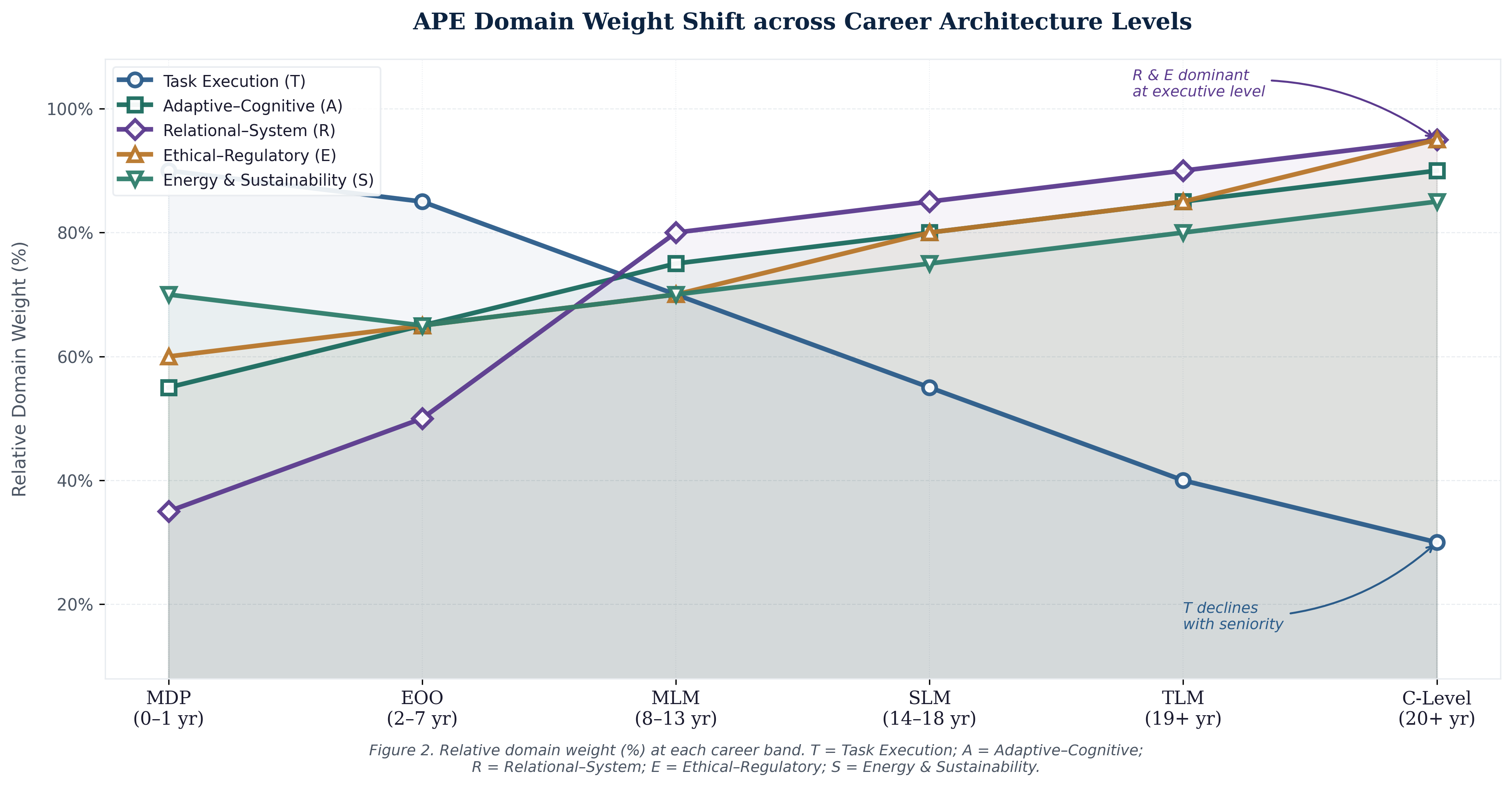
Figure 2. APE Domain Weight Shift across Career Architecture Levels. T = Task Execution declines with seniority; A = Adaptive–Cognitive grows steadily; R = Relational–System and E = Ethical–Regulatory rise steeply at executive levels.
8.4 Promotion Readiness Matrix
Table 2 presents the full APE Promotion Readiness Matrix. Bold percentages indicate primary promotion criteria (≥80%) at each level. The CWB Gate operates as a categorical veto at every band transition — regardless of how strong the domain scores are.
Table 2. APE Theory Promotion Readiness Matrix by Career Band
| Career Band | T | A | R | E | S | CWB Veto | Key Promotion Signals |
|---|---|---|---|---|---|---|---|
| MDP 0–1 yr MTO | 90% | 55% | 35% | 60% | 70% | Absenteeism; insubordination | Task delivery · Learning speed · Compliance |
| EOO 2–7 yr Asst – Sr Officer | 85% | 65% | 50% | 65% | 65% | Peer conflict; deadline failure | Consistent KPI · Tool adoption · Peer helpfulness |
| MLM 8–13 yr Asst – Chief Mgr | 70% | 75% | 80% | 70% | 70% | Blame-shifting; morale drain | Team coordination · Cross-unit links · AI use |
| SLM 14–18 yr AG – Chief GMgr | 55% | 80% | 85% | 80% | 75% | Resource hoarding; ethical grey areas | Strategic adaptation · Network breadth · Regulatory judgement |
| TLM 19+ yr AVP – VP | 40% | 85% | 90% | 85% | 80% | CWB culture; ethical compromise | Systems thinking · VP-level networks · Sustainable leadership |
| C-Level 20+ yr CMO/CFO/CHRO/CEO | 30% | 90% | 95% | 95% | 85% | ANY CWB; regulatory failure | Enterprise R+E dominance · Feedback strategy · Energy model |
Note. Bold = primary promotion criteria (≥80%). CWB = categorical veto at all transitions.
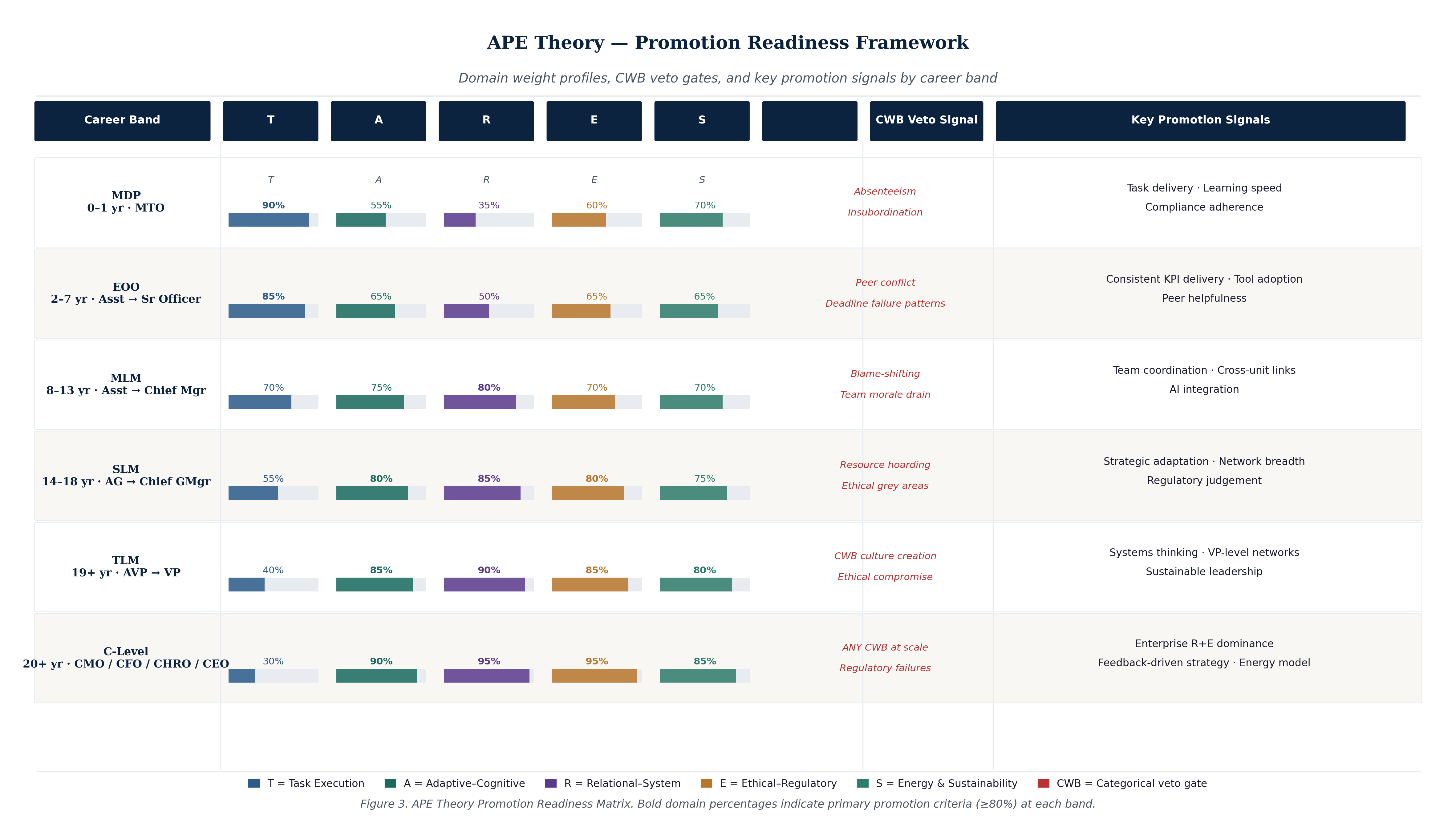
Figure 3. APE Theory Promotion Readiness Framework — Visual Matrix. Bar charts depict relative domain weight at each career band. Bold percentages indicate primary promotion criteria (≥80%). The CWB column indicates categorical veto gate conditions.
8.5 Promotion Gate Architecture
Figure 4 depicts the gate logic for each of the five band transitions. No domain configuration, however strong, overrides a sustained CWB pattern.
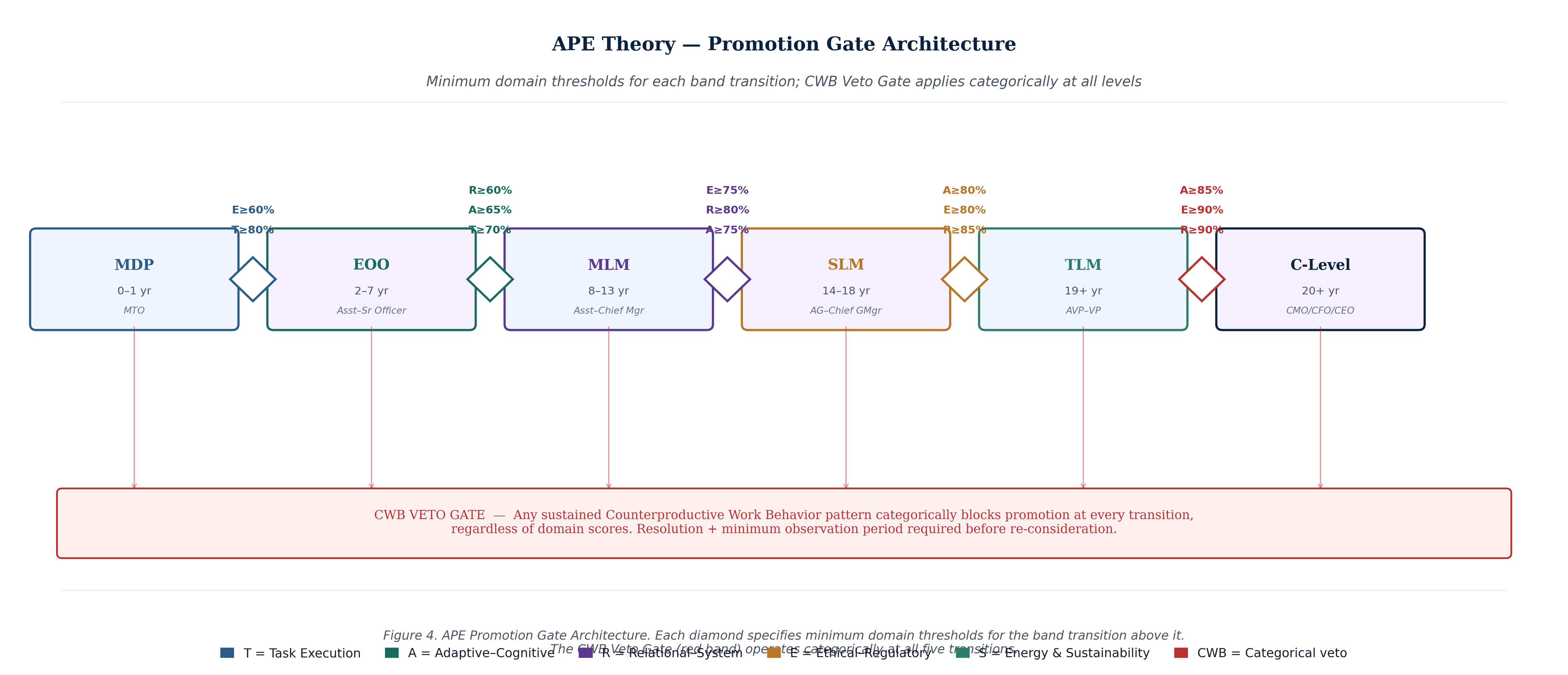
Figure 4. APE Promotion Gate Architecture. Each diamond node specifies minimum domain weight thresholds for the corresponding band transition. The CWB Veto Gate (red band) applies categorically at every transition.
Table 3. APE Theory Promotion Gate Criteria by Band Transition
| Band Transition | Minimum APE Threshold | CWB Veto Signal | Q-Sort Validation Criterion |
|---|---|---|---|
| MDP → EOO | T≥80%, E≥60%, A≥50% | Absenteeism or insubordination | Task domain mean ≥+2; CWB statements ≤−1 |
| EOO → MLM | T≥70%, A≥65%, R≥60%, E≥65% | Peer conflict or morale deterioration | Relational mean positive; PSR-2 references team |
| MLM → SLM | A≥75%, R≥80%, E≥75%, S≥65% | Blame-shifting or resource withholding | PSR-2 references system, not just individual task |
| SLM → TLM | R≥85%, E≥80%, A≥80%, S≥75% | Ethical grey areas; CWB culture signals | Candidate +5 placements cluster in R or E domain |
| TLM → C-Level | R≥90%, E≥90%, A≥85%, S≥80% | ANY CWB at scale; regulatory incident | All five domain means positive; AI feedback integration positive |
8.6 Applicability to the Q-Sort Instrument
The APE Promotion Readiness Framework is directly operationalizable through the APE Theory Q-Sort instrument. Candidates complete the bilingual survey; domain mean scores are compared against target-band thresholds.
Key Q-sort promotion-readiness signals:
- PSR-2 (Definition of Performance): candidates whose narrative centres team, system, or ethical terms demonstrate MLM-and-above alignment
- PSR-6 (Extremes Analysis): candidates whose +5 placements cluster in R and E demonstrate SLM-and-above alignment
- AI Tool Usage: candidates reporting “Regularly” or “Central to my role” demonstrate domain A readiness for MLM threshold and above
- CWB domain mean: any positive mean CWB score triggers a veto flag at any level
8.7 New Hypothesis — Promotion Readiness Validity
8.8 Practical Implications
The APE Promotion Readiness Framework offers three practical tools for HR professionals: a principled domain-profile benchmark for each band transition; CWB operationalized as a categorical risk signal; and structured promotion review conversations anchored to empirically-derived thresholds. The framework is particularly applicable in large, multi-tiered workforces — including the Bangladesh readymade garment (RMG) sector — where promotion decisions for thousands of employees across six functional bands require a scalable, evidence-based methodology.
9. Conclusion
This paper has introduced Adaptive Performance Ecology (APE) Theory, a system-level reconceptualization of job performance designed for the analytical and practical demands of AI-enabled organizational environments. By foregrounding the dynamic, relational, and ecologically embedded nature of performance, APE Theory addresses three persistent limitations of the existing literature: the absence of formal dynamic modeling, the insufficient integration of AI systems, and the neglect of ethical and sustainability dimensions as core performance constructs.
The framework’s five interdependent domains — Task Execution, Adaptive–Cognitive, Relational–System, Ethical–Regulatory, and Energy & Sustainability Performance — are formalized through a dynamic systems model. The APE Theory Promotion Readiness Framework extends this foundation into practice, providing principled domain-profile benchmarks and CWB veto gate criteria for each of six career band transitions. Future research should empirically validate APE Theory across sectors, with the promotion readiness hypothesis (H7) as a particularly tractable near-term target.
References
Borman, W. C., & Motowidlo, S. J. (1997). Task performance and contextual performance: The meaning for personnel selection research. Human Performance, 10(2), 99–109. https://doi.org/10.1207/s15327043hup1002_3
Brynjolfsson, E., & McAfee, A. (2014). The second machine age: Work, progress, and prosperity in a time of brilliant technologies. W. W. Norton & Company.
Campbell, J. P. (1990). Modeling the performance prediction problem in industrial and organizational psychology. In M. D. Dunnette & L. M. Hough (Eds.), Handbook of industrial and organizational psychology (2nd ed., Vol. 1, pp. 687–732). Consulting Psychologists Press.
Hobfoll, S. E. (1989). Conservation of resources: A new attempt at conceptualizing stress. American Psychologist, 44(3), 513–524. https://doi.org/10.1037/0003-066X.44.3.513
Pulakos, E. D., Arad, S., Donovan, M. A., & Plamondon, K. E. (2000). Adaptability in the workplace: Development of a taxonomy of adaptive performance. Journal of Applied Psychology, 85(4), 612–624. https://doi.org/10.1037/0021-9010.85.4.612
Sterman, J. D. (2000). Business dynamics: Systems thinking and modeling for a complex world. McGraw-Hill/Irwin.
Trist, E. L., & Bamforth, K. W. (1951). Some social and psychological consequences of the longwall method of coal-getting. Human Relations, 4(1), 3–38. https://doi.org/10.1177/001872675100400101
Watts, S., & Stenner, P. (2012). Doing Q methodological research: Theory, method and interpretation. SAGE Publications.


Leave a Reply