The 4Q Employee Classification Model (ECM): A Strategic Workforce Architecture Framework for Manufacturing Organisations in the AI Era
Abdulla Al Babul · Researcher & Writer | AI, Future Work, Technology, Sustainable Manufacturing, and Society · March 2026
Employee classification has long served as a foundational component of workforce administration. Traditional classifications — Worker, Staff, and Management — have been widely adopted across manufacturing industries to support payroll administration, labour-law compliance, reporting structures, and organisational control. Yet these classifications were designed primarily for administrative purposes and offer limited guidance for strategic workforce planning, manpower budgeting, organisational development, workforce analytics, and artificial-intelligence (AI)-driven transformation.
Drawing on fifteen years of professional practice and organisational observation across medium and large manufacturing organisations in Bangladesh, this paper introduces the Employee Classification Model (ECM) — a strategic workforce-architecture framework that aligns workforce structure with business objectives and operational performance. The ECM classifies employees along two dimensions, Employment Layer (Labour and Staff) and Role Function (Operations and Support), producing four workforce segments: Labour Operations, Labour Operations Support, Staff Operations, and Staff Operations Support. The paper argues that workforce sustainability and competitiveness depend not only on workforce size but on the strategic balance among these segments, marking a shift from workforce administration toward strategic workforce management.
Keywords: Employee Classification, Workforce Architecture, Human Resource Management, Workforce Planning, HR Analytics, Organisational Development, Manufacturing Industry, Artificial Intelligence, Industry 4.0.
1. Introduction
Human capital remains one of the most critical resources for organisational success. Across manufacturing industries, employee-classification systems provide the foundation for workforce administration, compensation management, reporting relationships, and organisational control. For decades, organisations have typically classified employees into categories such as Worker and Staff; Worker, Staff and Management; or Worker, Factory Staff and Management.
These systems continue to serve important administrative and regulatory functions. However, growing organisational complexity, rising workforce costs, technological disruption, and competitive pressure have exposed significant limitations in traditional classification frameworks. Modern organisations are expected to manage workforce productivity, optimise labour costs, align capabilities with business objectives, and prepare employees for technological change — objectives that traditional classifications, focused on hierarchy rather than contribution, support only weakly.
The emergence of artificial intelligence, Industry 4.0, automation, robotics, and workforce analytics further sharpens the need for workforce structures capable of supporting data-driven management. This paper introduces the Employee Classification Model (ECM), a workforce-architecture framework developed through extensive practical observation within Bangladesh’s manufacturing sector. The purpose of the ECM is not to replace traditional classifications but to complement them — providing a strategic lens through which organisations can understand workforce contribution, organisational alignment, and value creation.
2. Background and Problem Statement
Despite advances in management science and human-resource practice, many manufacturing organisations continue to face recurring workforce-management challenges. Based on fifteen years of professional practice across medium and large organisations in Bangladesh, several persistent issues recur:
2.1 Ineffective Manpower Budgeting
Headcount planning is frequently based on historical staffing patterns rather than operational requirements and business strategy.
2.2 Rising Workforce Costs
Organisations often experience continuous growth in workforce expense without corresponding gains in productivity or operational performance.
2.3 Organisational Misalignment
Departments frequently operate independently, producing inconsistent priorities and fragmented objectives.
2.4 KPI Misalignment
Performance-measurement systems are often designed without accounting for the distinct contributions of different workforce groups.
2.5 Recruitment Inefficiencies
Although organisations speak of placing “the right people in the right place at the right time,” practical workforce-architecture frameworks capable of supporting that aim are usually absent.
2.6 Limited Workforce Visibility
Traditional classifications reveal little about workforce contribution, productivity, or the effectiveness of workforce investment. As a result, organisations struggle to optimise allocation, manage people costs, and sustain growth.
3. Literature Review
Classical organisational theories focused primarily on hierarchical authority and administrative control. Taylor’s Scientific Management emphasised the distinction between management and labour, and later theories expanded classifications to include supervisory, professional, technical, and administrative personnel. While these frameworks remain valuable, modern organisations increasingly require workforce structures that support strategic human-resource management, workforce analytics, human-capital optimisation, organisational agility, digital transformation, and AI integration.
Recent developments in human-capital analytics and workforce planning suggest that classification systems should move beyond reporting structures toward value creation and organisational contribution. Existing classifications, however, continue to centre on employment status and hierarchy. The ECM addresses this gap by introducing a workforce-architecture perspective organised around contribution and operational alignment.
4. Research Methodology and Model Development
4.1 Research Approach
This study adopts a qualitative, practice-based conceptual research approach. The ECM was developed through professional experience, workplace observation, organisational diagnosis, and workforce-management practice within manufacturing industries in Bangladesh. Unlike models derived purely from theory, the ECM emerged from practical challenges observed across multiple sectors over a fifteen-year period, combining elements of experiential-learning theory, practice-based research, organisational observation, workforce-management analysis, and conceptual model development.
4.2 Industry Context
Development was informed by involvement in medium and large manufacturing organisations across Ready-Made Garments (RMG), textile manufacturing, printing, packaging, accessories, and consumer-goods production — collectively among the largest employment-generating sectors in Bangladesh, providing an appropriate environment for examining workforce structures and organisational effectiveness.
4.3 Sources of Observation
The model draws on experience across workforce-planning activities (annual manpower budgeting, headcount forecasting, restructuring, productivity initiatives), HR practices (recruitment, performance management, talent development, organisational design), organisational-development projects (restructuring, departmental effectiveness reviews, KPI development, optimisation programmes), and regular engagement with managing directors, factory heads, production managers, department heads, supervisors, and employees.
4.4 Identification of Organisational Challenges
A consistent pattern emerged across companies: traditional classifications provided limited support for understanding how workforce investment contributed to operational performance and business objectives. This observation became the primary motivation for a new workforce-architecture framework.
4.5 Conceptual Development Process
The ECM was developed iteratively in four stages: (1) Workforce Observation — analysis of workforce structures and roles; (2) Functional Role Mapping — identifying contribution based on work actually performed rather than title or reporting level; (3) Workforce Segmentation — grouping employees by employment category and functional contribution; and (4) Framework Validation — continuous review against real-world manpower planning, KPI development, organisational design, and budgeting challenges. This process produced the four-segment structure of the ECM.
4.6 Limitations
This study is conceptual and grounded in professional observation within Bangladesh’s manufacturing sector; empirical testing has not yet been conducted. Future research should validate the ECM through survey-based studies, multi-industry case studies, workforce-productivity analysis, structural equation modelling (SEM), and HR-analytics research.
5. The Employee Classification Model
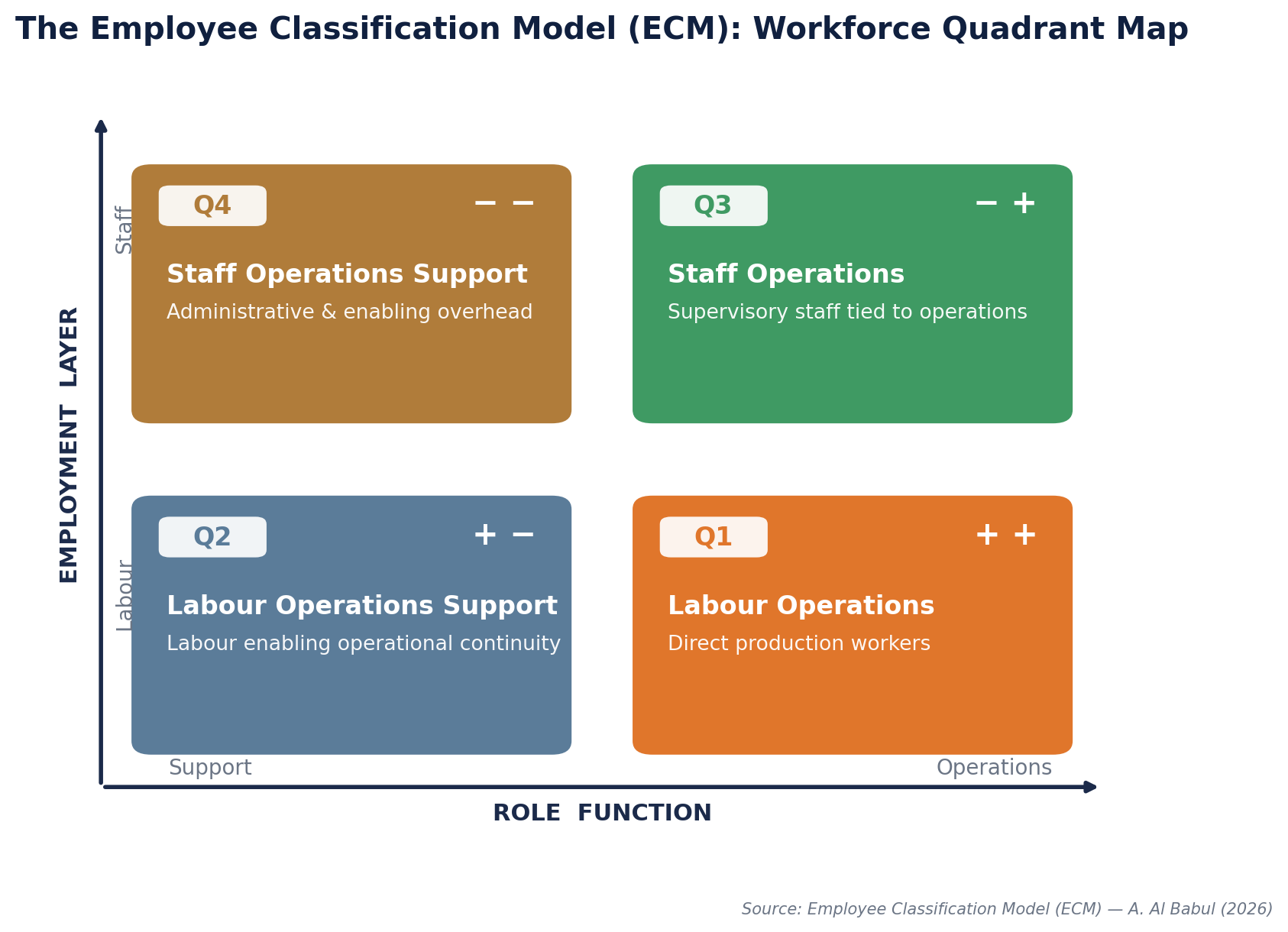
The ECM rests on two fundamental dimensions. Dimension One — Employment Layer distinguishes Labour from Staff. Dimension Two — Role Function distinguishes Operations from Support. Their interaction creates four workforce segments.
Q1Labour Operations
Employees directly involved in production and value-creation activities — for example sewing operators, knitting operators, machine operators, and printing operators. Primary objective: direct operational output and value creation.
Q2Labour Operations Support
Employees who sustain operational continuity without directly producing the product or service — helpers, material handlers, loaders, and warehouse-support personnel. Primary objective: operational continuity and resource flow.
Q3Staff Operations
Technical and supervisory personnel responsible for managing, controlling, and optimising operational performance — production supervisors, industrial engineers, quality supervisors, and production executives. Primary objective: operational effectiveness and performance optimisation.
Q4Staff Operations Support
Administrative and business-support personnel providing governance and organisational support — human resources, finance, information technology, procurement, and compliance. Primary objective: business support, governance, and organisational sustainability.
6. ECM Theory of Workforce Value Contribution
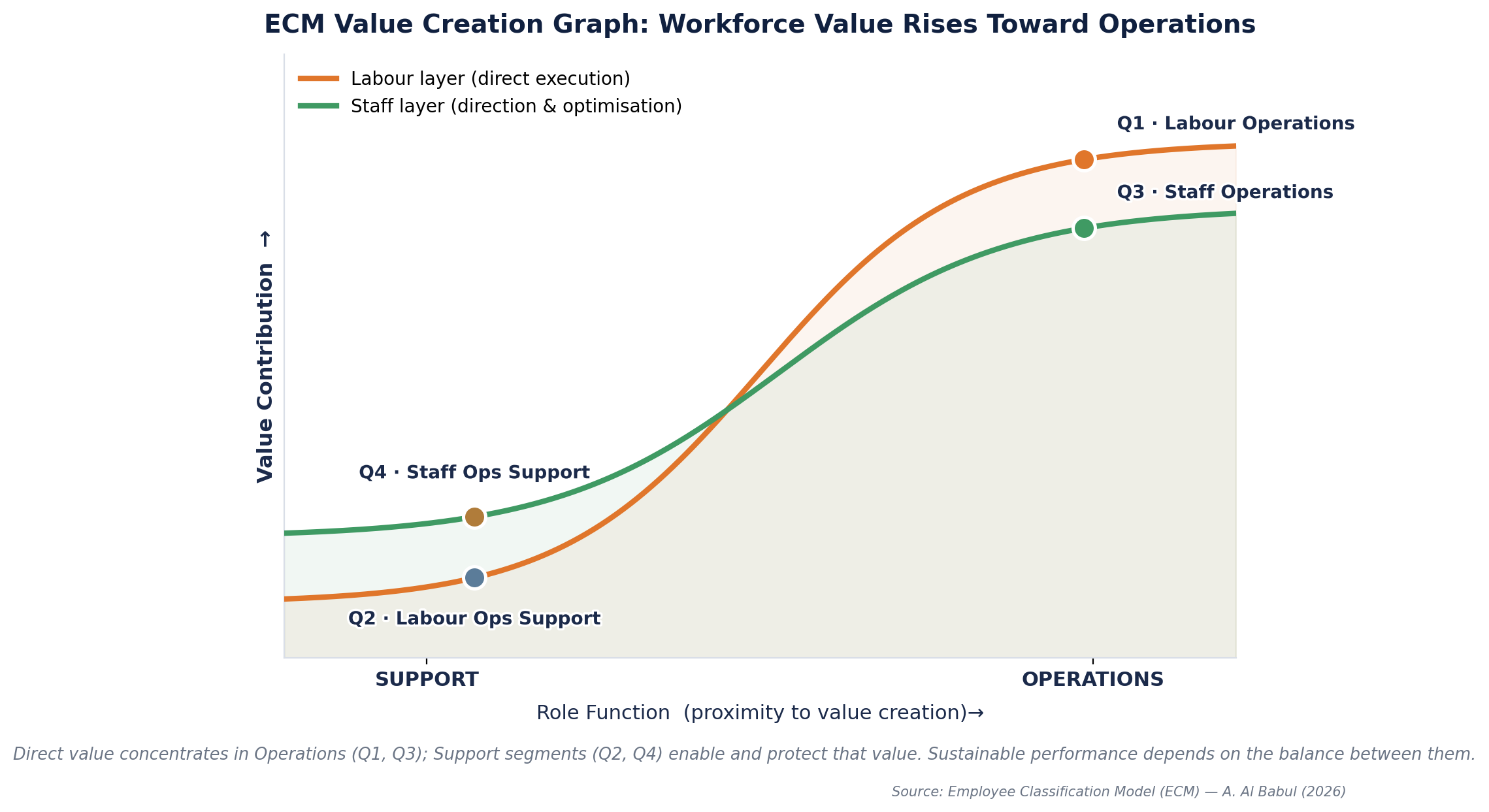
The central theoretical proposition of the ECM is that organisational performance is shaped not only by workforce size but by the strategic balance among workforce segments.
Organisations achieve higher productivity, cost efficiency, and sustainable performance when workforce investment is balanced across Labour Operations, Labour Operations Support, Staff Operations, and Staff Operations Support.
An imbalance among these segments can produce excessive administrative cost, operational bottlenecks, workforce inefficiency, reduced productivity, and organisational complexity. The ECM therefore treats workforce architecture as a strategic determinant of organisational performance. Figure 2 illustrates the underlying logic: value contribution rises as roles move toward Operations, while Support segments enable and protect that value rather than generating it directly.
7. The Three-Dimensional ECM: Adding Value Contribution
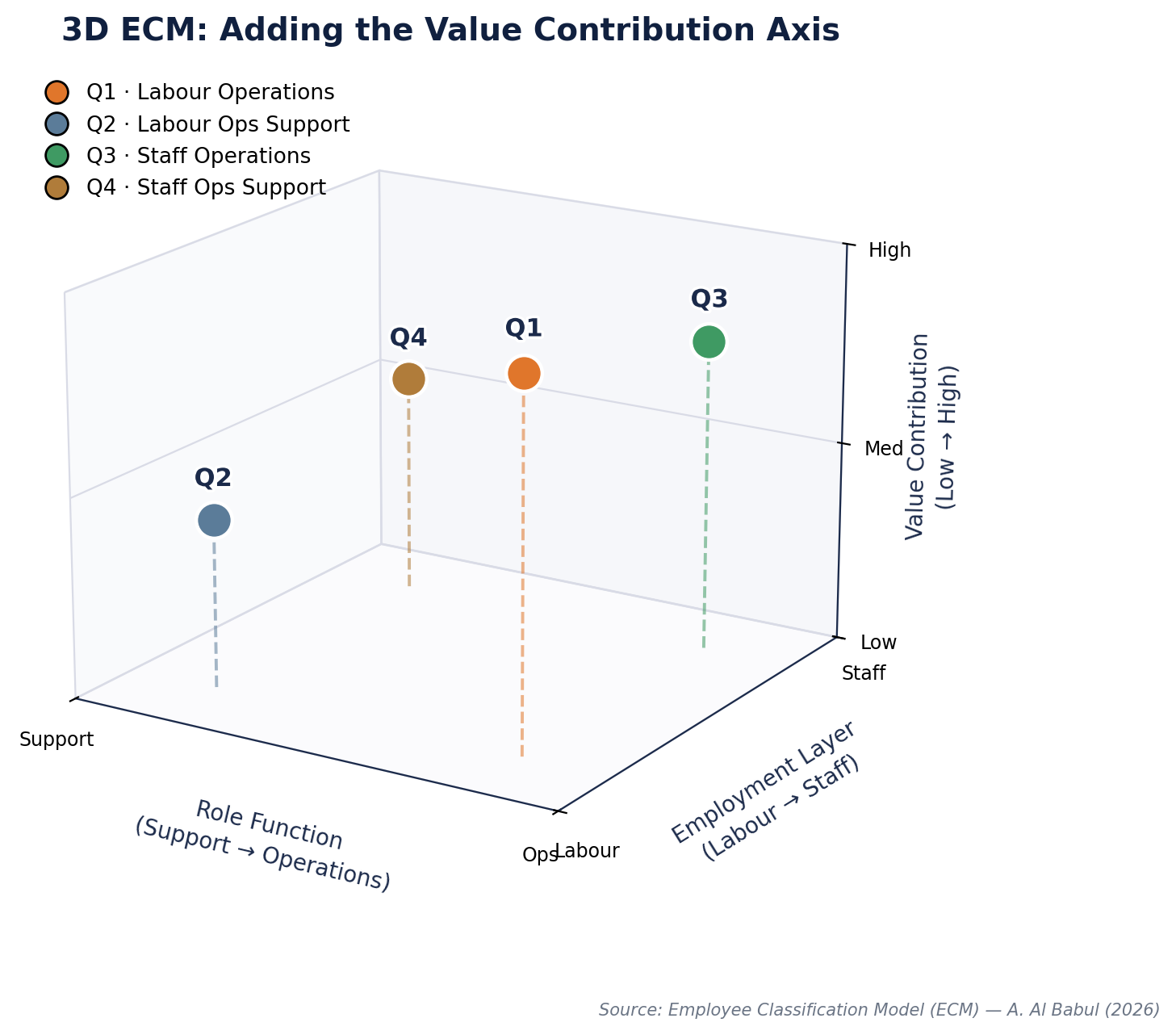
The original quadrant map positions employees on two axes. The extended model introduces a third axis — Value Contribution — turning the framework into a three-dimensional decision tool. Each employee is now evaluated across three axes:
- Axis X — Role Function: Support → Operations (how directly the role contributes to operations).
- Axis Y — Employment Layer: Labour → Staff (organisational position and responsibility level).
- Axis Z — Value Contribution: Low → High (business impact — revenue contribution, productivity impact, risk reduction, innovation, and cost saving).
In practice, value contribution is captured with a simple scoring scale that can be applied at the individual, team, or segment level:
| Value Level | Score |
|---|---|
| Very High | 5 |
| High | 4 |
| Medium | 3 |
| Low | 2 |
| Very Low | 1 |
Because the current ECM already captures headcount, salary cost, and benefit cost by segment, adding a value score allows cost and value to be analysed together — the basis for the strategic analysis in Section 8.
8. Cost × Value Strategic Analysis
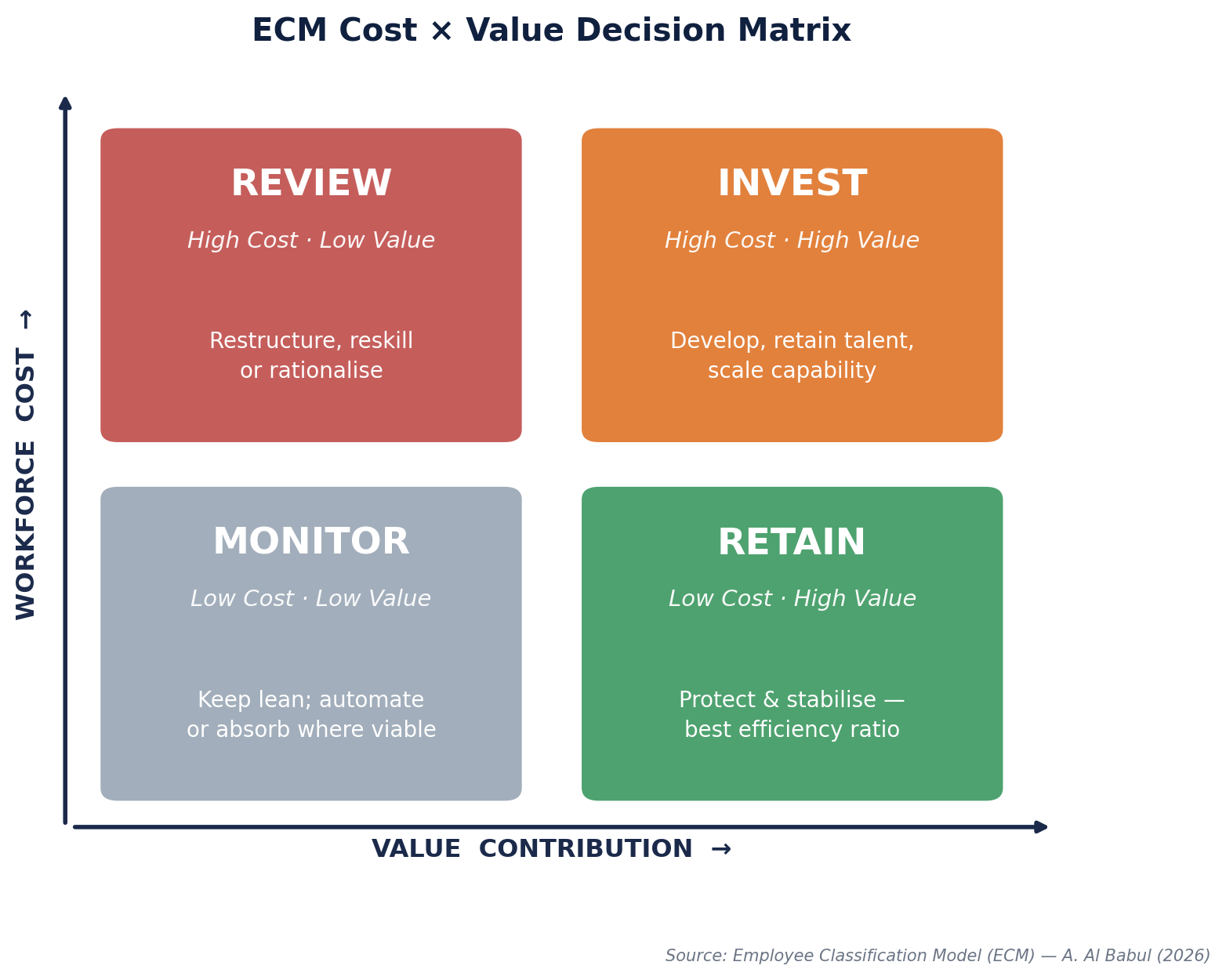
With cost and value measured on common terms, management can position every workforce segment — or individual role — on a Cost × Value matrix and read a clear strategic action from its position.
| Cost | Value | Strategic Decision |
|---|---|---|
| Low Cost | High Value | Retain — protect and stabilise; strongest efficiency ratio |
| High Cost | High Value | Invest — develop, retain talent, scale capability |
| Low Cost | Low Value | Monitor — keep lean; automate or absorb where viable |
| High Cost | Low Value | Review — restructure, reskill, or rationalise |
9. Strategic and Economic Significance
Traditional classifications answer administrative questions about hierarchy and reporting. The ECM extends classification to address workforce contribution and value creation, helping organisations see where workforce investment is concentrated, which groups generate operational value, and how workforce resources support business objectives.
Economic perspective. By distinguishing value-generating from support activities, the ECM improves manpower budgeting, optimises allocation, reduces unnecessary expansion, and improves resource utilisation. Financial perspective. Linking workforce cost to operational function sharpens people-cost visibility — enabling analysis of cost by segment, labour-to-staff ratios, operations-to-support ratios, administrative-cost growth, and productivity-related investment. Organisational perspective. The framework promotes role clarity, accountability, KPI alignment, integration, and workforce transparency.
10. Workforce Analytics and the AI Era
Adopting AI and workforce analytics requires data structures capable of supporting advanced organisational analysis. The ECM integrates naturally into HR-analytics platforms, HRIS, ERP systems, workforce-planning models, and AI-based forecasting tools, enabling organisations to monitor workforce trends and build evidence-based strategy.
As AI reshapes workforce structures worldwide, organisations increasingly need to identify value-creating roles, automatable activities, reskilling priorities, and future workforce requirements. Because the ECM separates operational from support activity, it helps organisations identify automation opportunities while preserving critical human capability — positioning it as a workforce-architecture framework for Industry 4.0 and AI-enabled organisations.
11. Practical Applications
| Domain | Applications |
|---|---|
| Human Resource Management | Workforce planning, recruitment planning, talent management, succession planning |
| Organisational Development | Organisational design, span-of-control analysis, workforce restructuring |
| Financial Management | Headcount budgeting, cost optimisation, productivity analysis |
| Manufacturing Operations | Workforce-productivity measurement, capacity planning, operational-efficiency improvement |
12. Conclusion
Traditional employee-classification systems remain valuable for payroll administration, labour-law compliance, and organisational reporting. Yet they offer limited support for modern challenges in manpower budgeting, workforce analytics, organisational effectiveness, and AI-driven transformation. The Employee Classification Model complements them by focusing on workforce contribution, operational alignment, and value creation.
Developed through fifteen years of professional observation and management practice within Bangladesh’s manufacturing sector, the ECM gives organisations a practical mechanism for improving workforce visibility, manpower planning, KPI alignment, workforce analytics, and organisational performance. As organisations enter the era of AI and Industry 4.0, workforce architecture will only grow in importance — and the ECM offers a foundation for understanding contribution, optimising investment, and sustaining competitiveness.
Future Research Directions
Future studies should empirically validate the ECM through multi-industry case studies, workforce-productivity analysis, HR-analytics applications, structural equation modelling (SEM), workforce-cost-optimisation studies, and AI-readiness assessments — further strengthening its theoretical foundation and establishing its relevance as a strategic workforce-management framework.
© 2026 Abdulla Al Babul. The Employee Classification Model (ECM) is an applied workforce-architecture framework grounded in manufacturing practice. Suggested citation: Al Babul, A. (2026). The Employee Classification Model (ECM): A Strategic Workforce Architecture Framework for Manufacturing Organisations in the AI Era. TWA.education.


Leave a Reply