By Abdulla Al Babul — Researcher & Writer | AI, Future of Work, Technology, Sustainable Manufacturing, and Society
ORSVAI: An Accountability Framework Built for Verification, Not Just Assignment
Right Person · Right Role · Right Time · Right Result — a complete accountability system for excellence, compliance, and continuous improvement.
Abstract. Most accountability failures in organizations are not failures of effort — they are failures of clarity. Work is assigned, but ownership is ambiguous; tasks are completed, but no one is charged with confirming that the result is real. This article introduces ORSVAI (Owner, Responsible, Support, Verify, Approve, Inform), a six-role accountability framework developed from fifteen years of practice in industrial and ready-made garment (RMG) manufacturing environments. ORSVAI extends the familiar RACI logic in two decisive ways: it makes ownership singular and non-negotiable, and it embeds verification into the accountability structure itself rather than leaving result-checking to chance.
1. The Problem: Diffuse Accountability
Ask any operations leader why a critical task slipped, and the answer is rarely “no one worked on it.” Far more often, the answer is some version of: everyone thought someone else was responsible. In matrixed organizations — and industrial manufacturing is deeply matrixed, with production, compliance, HR, maintenance, and commercial functions all touching the same initiatives — accountability diffuses naturally unless a framework actively concentrates it.
The costs of diffusion are familiar: audit findings that recur year after year, facility development projects that stall at eighty percent, corrective actions that are “closed” on paper but never validated on the floor. In compliance-intensive sectors such as RMG, where third-party audits (structural safety, fire safety, social compliance, environmental certification) carry commercial consequences, unverified completion is not a minor inefficiency — it is a business risk.
2. Why RACI Is Not Enough
RACI (Responsible, Accountable, Consulted, Informed) has been the default responsibility-assignment matrix for decades, and it deserves its longevity. But in field application, RACI shows three persistent weaknesses:
- The R/A confusion. Practitioners routinely conflate “Responsible” and “Accountable.” In many charts the same person holds both, or multiple people share the A — which defeats the purpose entirely.
- No verification role. RACI assumes that when the Responsible party reports completion, the task is done. There is no structural role whose job is to independently confirm that the outcome exists and meets the standard. In audit-driven environments, this is the single most damaging gap.
- “Consulted” is passive. Consultation describes a communication pattern, not a working contribution. It tells you who to talk to, not who will actually lend hands, resources, or expertise to the work.
3. The ORSVAI Model
ORSVAI assigns six distinct roles to every task, project, or accountability item. Figure 1 presents the complete framework.
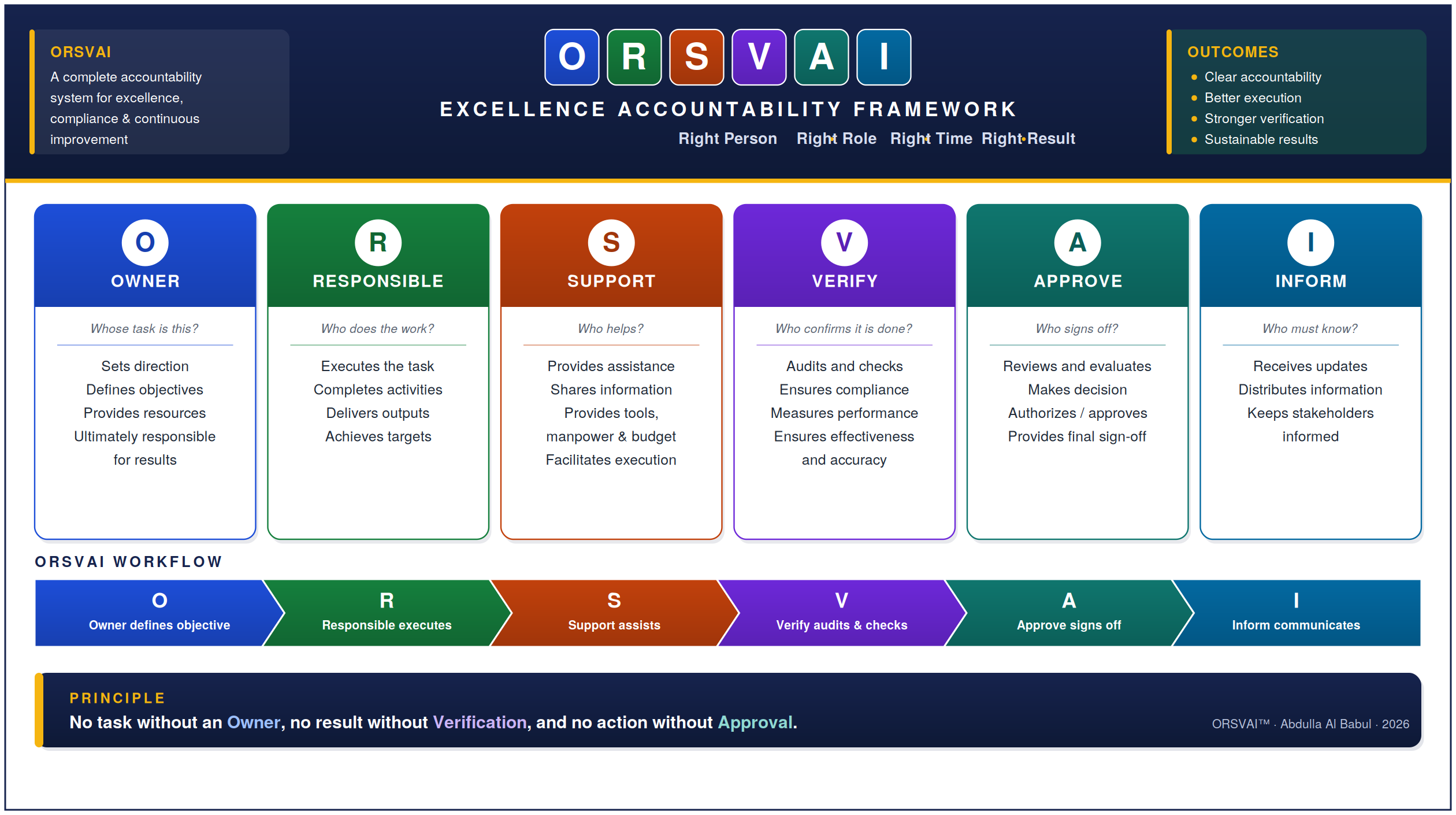
| Role | Question it answers | Core obligation |
|---|---|---|
| O — Owner | Whose task is this? | Holds ultimate, singular accountability for the outcome. Exactly one Owner per task — no task exists without one. |
| R — Responsible | Who does the work? | Executes the task day to day and reports progress to the Owner. |
| S — Support | Who helps? | Contributes tools, manpower, budget, information, and expertise. Support is an active working role, not a courtesy consultation. |
| V — Verify | Who confirms it is really done? | Audits and checks the completed work — compliance, performance, effectiveness, and accuracy — before it can be approved. The Verifier must be distinct from the Responsible party. |
| A — Approve | Who signs off? | Reviews, evaluates, decides, and provides final sign-off, typically at a senior or board level, after verification. |
| I — Inform | Who must know? | Receives updates and distributes outcome communication — stakeholders kept informed without a working role. |
On small screens, swipe the table horizontally to view all columns.
4. Design Principles
First principle: no task is saved without an Owner. In ORSVAI implementations, this is enforced structurally — a task literally cannot enter the tracking system without a named Owner. Ambiguity is removed at the point of creation, not negotiated later.
Second principle: completion is a claim; verification is a fact. The Verify role is what most distinguishes ORSVAI from RACI. Between “the work is done” (Responsible) and “the work is accepted” (Approve) sits an independent checkpoint. In practice this maps naturally onto how audits already work — an internal verifier confirms readiness before the external auditor arrives — but ORSVAI generalizes the pattern to all organizational work, not only compliance items.
Third principle: separation of duties. Owner, Verify, and Approve are held by different people wherever organizational size permits. This creates a lightweight internal-control structure inside ordinary task management, without the bureaucracy of a formal audit function.
Fourth principle: visible progression. ORSVAI items move through a defined progress scale (for example, a six-stage scale from Not Started through In Progress, Completed — Awaiting Verification, Verified, Approved, and Closed). The stages make the verification gap visible: a dashboard full of “completed but unverified” items tells leadership something a simple percent-complete number never could.
The ORSVAI Principle: No task without an Owner, no result without Verification, and no action without Approval.
5. Applications in Industrial Practice
ORSVAI was developed and refined inside Bangladesh’s RMG and footwear manufacturing sector, and its most mature applications reflect that origin:
- Board-level accountability dashboards, where each department’s commitments are logged with full ORSVAI role assignment and reviewed against the six-stage scale in monthly board meetings.
- Audit readiness programs (structural, fire, social, and environmental compliance), where the Verify role formalizes internal pre-audit confirmation and dramatically reduces repeat findings.
- Facility development and Just-in-Time implementation projects, where cross-departmental task matrices assign all six roles across dozens of implementation tasks, with gamified departmental leaderboards sustaining engagement.
The framework is deliberately technology-agnostic — it works on a whiteboard — but digital implementations (accountability matrices, tracking dashboards, and scoring engines) make its verification discipline routine rather than heroic.
6. ORSVAI and Performance-First Management
Recent management thinking — including work featured in Harvard Business Review in 2026 — describes a shift toward performance-first management: a philosophy that retains a people-centered lens while re-anchoring managerial attention on delivering measurable, high-impact results. The reported evidence suggests managers who adopt this orientation are substantially more likely to deliver expected business outcomes, with employee satisfaction holding up rather than declining.
ORSVAI is best understood as an enabling architecture for this philosophy. Performance-first management fails without clear accountability: results cannot be managed if no one owns them, and results cannot be trusted if no one verifies them. ORSVAI supplies both preconditions. The singular Owner concentrates accountability; the Verify role converts reported performance into confirmed performance. In an integrated management operating system — alongside workforce classification models and KPI-linked compensation — ORSVAI is the accountability layer on which performance measurement can safely rest.
7. Implementation Guidance
- Start with one high-stakes domain — audit readiness or a board-tracked project — where the cost of unverified completion is already felt.
- Enforce the Owner rule from day one. Reject any task submission without a named Owner. This single constraint changes behavior faster than any training session.
- Appoint Verifiers deliberately. Choose people with the standing and independence to say “not yet” — and protect that independence.
- Make the verification gap visible. Report “completed vs. verified” as separate numbers in every review meeting.
- Reward closure, not activity. Recognition, leaderboards, and incentives should attach to verified and approved outcomes.
8. Conclusion
Frameworks earn their keep by changing what happens on an ordinary Tuesday. ORSVAI’s contribution is modest in concept and large in consequence: one Owner for every task, and one independent check before anything is called done. In sectors where audits are existential and execution is everything, that discipline is the difference between accountability as a poster on the wall and accountability as an operating system.
© 2026 Abdulla Al Babul. ORSVAI™ is a proprietary framework developed by Abdulla Al Babul. Suggested citation: Abdulla A. B. (2026). ORSVAI: An Accountability Framework Built for Verification, Not Just Assignment. TWA.education.


Leave a Reply