Abdulla Al Babul
Researcher & Writer | AI, Future of Work, Technology, Sustainable Manufacturing, and Society · September 2026
ORSVAI for Sustainable AI Infrastructure
Who is responsible when AI consumes the future?
Artificial intelligence looks digital, but it stands on servers, GPUs, buildings, electricity, cooling water, minerals and networks. As that physical footprint grows, the decisive question shifts from what AI can do to who is accountable for the resources it consumes. This article proposes ORSVAI — Owner, Responsible, Support, Verify, Approve, Inform — as a responsibility architecture for AI infrastructure, and sets out a seven-gate decision method that tests sustainability before a facility is built rather than after.
AI is a digital promise built on a physical foundation
Behind every model, every chatbot, every generated image and every automated decision sits infrastructure: data centres, power, cooling systems, semiconductors and eventually electronic waste. That foundation creates a question the AI era has not yet answered well.
The answer cannot be “the sustainability department.” It cannot be “the data-centre team,” or “the AI engineer,” or “the government.” Sustainable AI needs something more basic than a department — it needs a clear architecture of responsibility.
Sustainable AI is not only about green energy
Most discussions open with electricity and carbon. Both matter. But AI infrastructure also draws water for cooling, materials for hardware, land for facilities, minerals for semiconductors, transport and construction — and it leaves obsolete equipment behind. Six dimensions deserve attention together, and the sixth is what holds the other five in place.
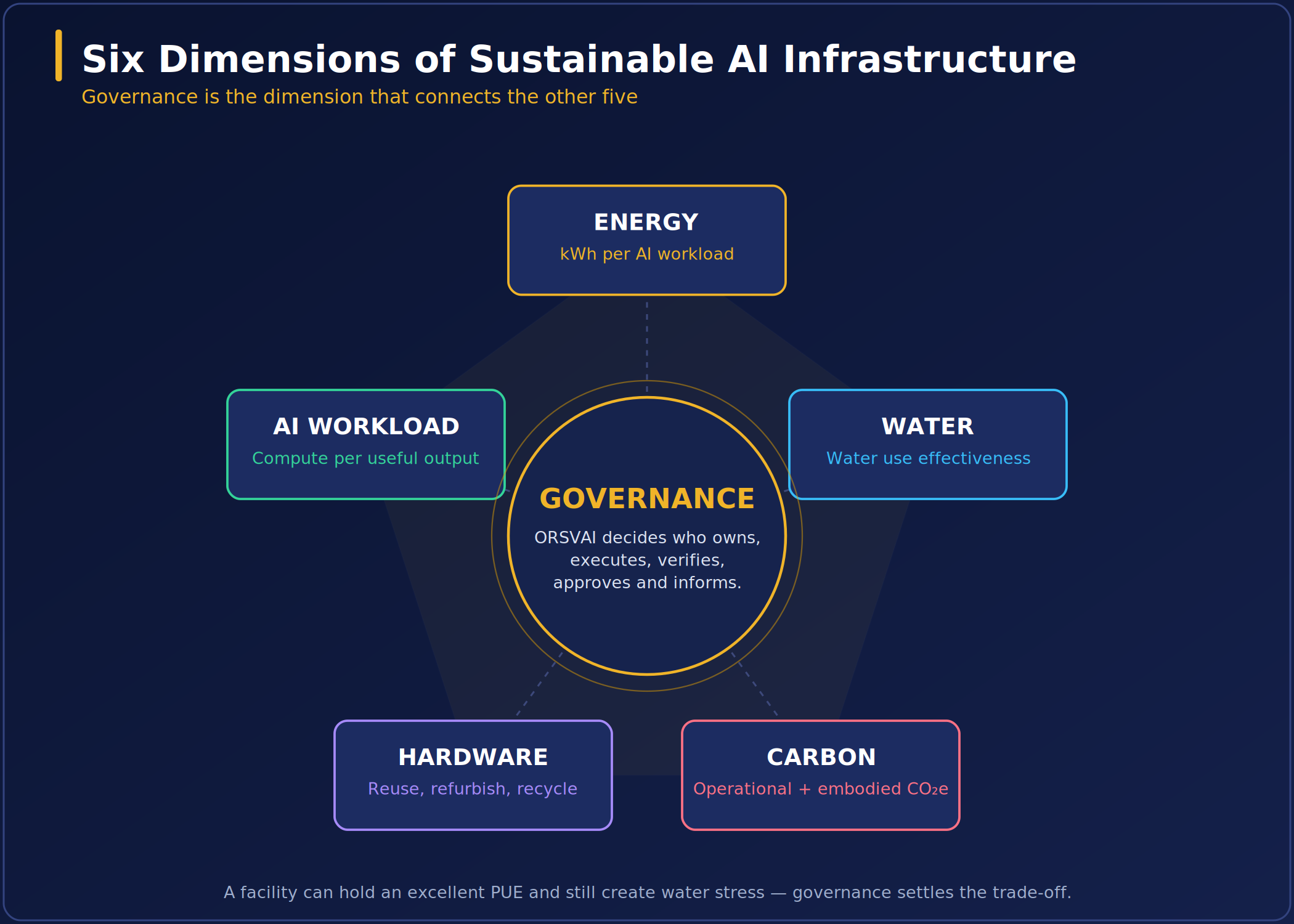
Energy
Can the facility run efficiently without straining the electricity system it sits on?
Water
Can cooling operate without placing unacceptable pressure on local water resources?
Carbon
What are the operational and embodied emissions across the whole lifecycle?
Hardware
What happens to GPUs and servers once they become obsolete?
AI workload
Does the value created justify the computational resource consumed?
Governance
Who owns, executes, verifies, approves and communicates these decisions?
The hidden problem: responsibility gaps
Picture a company building a new AI data centre. Engineering designs it. IT specifies the compute. Procurement buys the equipment. Finance approves the investment. Facilities runs the cooling. Sustainability writes the report. The regulator issues the permit. Every step has an owner — and yet the outcome often has none.
Suppose water consumption runs above forecast. Who answers for it? Suppose demand strains the local grid — who decides whether expansion continues? Suppose the site posts an excellent PUE while creating water stress: has it actually become sustainable? Suppose a workload burns enormous compute for very little value — who has standing to question it? These are not engineering questions. They are governance questions.
When everyone is responsible, nobody is accountable. A responsibility matrix that names departments instead of decisions is a record of intention, not of control.
ORSVAI: a chain of six roles
ORSVAI answers one question in six parts: who does the work, who owns the outcome, who supports it, who checks it, who authorises it, and who needs to know.
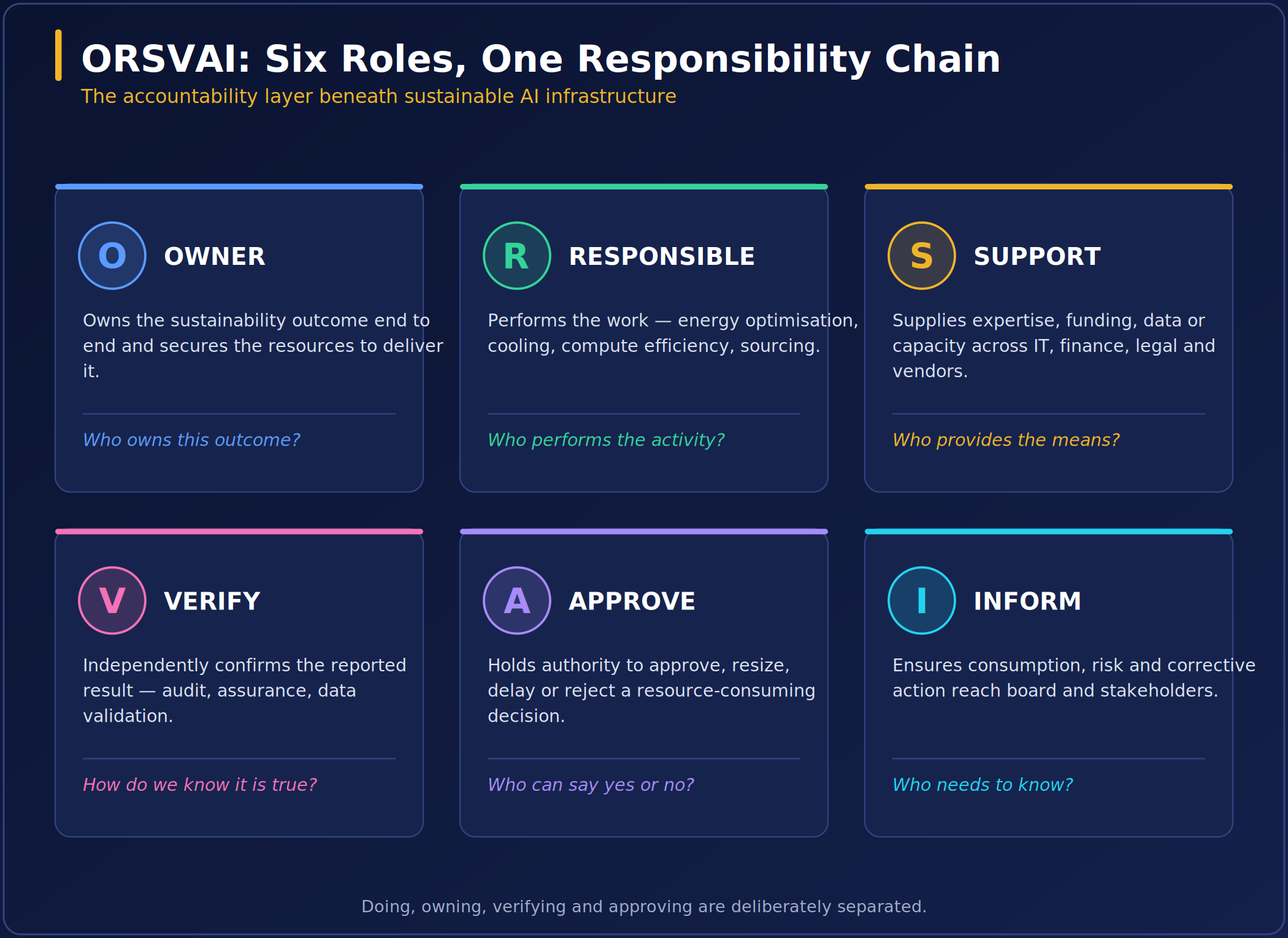
| Role | What it carries | Core question |
|---|---|---|
| O — Owner | Owns the outcome, not every task. Makes sure the system exists, the resources are available and the result is achieved. | Who ultimately owns this outcome? |
| R — Responsible | Performs the work: energy optimisation, cooling and water management, compute efficiency, sustainable sourcing. | Who performs the activity? |
| S — Support | Supplies resources and expertise — IT, finance, procurement, engineering, legal, vendors, energy providers, specialists. | Who provides the means? |
| V — Verify | Confirms the reported result independently: internal audit, environmental assessment, data validation, assurance, inspection. | How do we know the result is correct? |
| A — Approve | Holds authority over consequential decisions: new capacity, added GPUs, higher water withdrawal, large hardware purchases. | Who can say yes or no? |
| I — Inform | Keeps consumption, impact, risk, performance and corrective action visible outside the silo that produced them. | Who needs to know? |
Why RACI is not enough here
RACI — Responsible, Accountable, Consulted, Informed — has served project and process management well. AI infrastructure stretches it, because environmental decisions need two separations that RACI leaves implicit.
The person operating a cooling system should not be the person certifying its environmental performance. The person preparing an infrastructure proposal should not be the person approving the investment. ORSVAI makes verification and approval distinct roles rather than assumed courtesies.
ORSVAI inside a data centre
Take a single objective: reduce water consumption in an AI data centre. Assigned through ORSVAI, it looks like this.
Objective: cut water consumption per unit of compute
Owner Infrastructure Director
Responsible Data Centre Facilities Manager
Support Cooling Engineer and Sustainability Team
Verify Internal Audit or independent environmental assurance
Approve Executive Sustainability Committee
Inform Board and affected stakeholders
If water use rises, the organisation now knows where to look. That is a different instrument from a line in a policy stating that facilities and sustainability are jointly responsible for water.
The Sustainable AI Decision Gate
ORSVAI also works before a project starts. Instead of asking only whether the infrastructure can be built, it asks six questions in sequence, then forces a decision with real options — including the option to refuse.
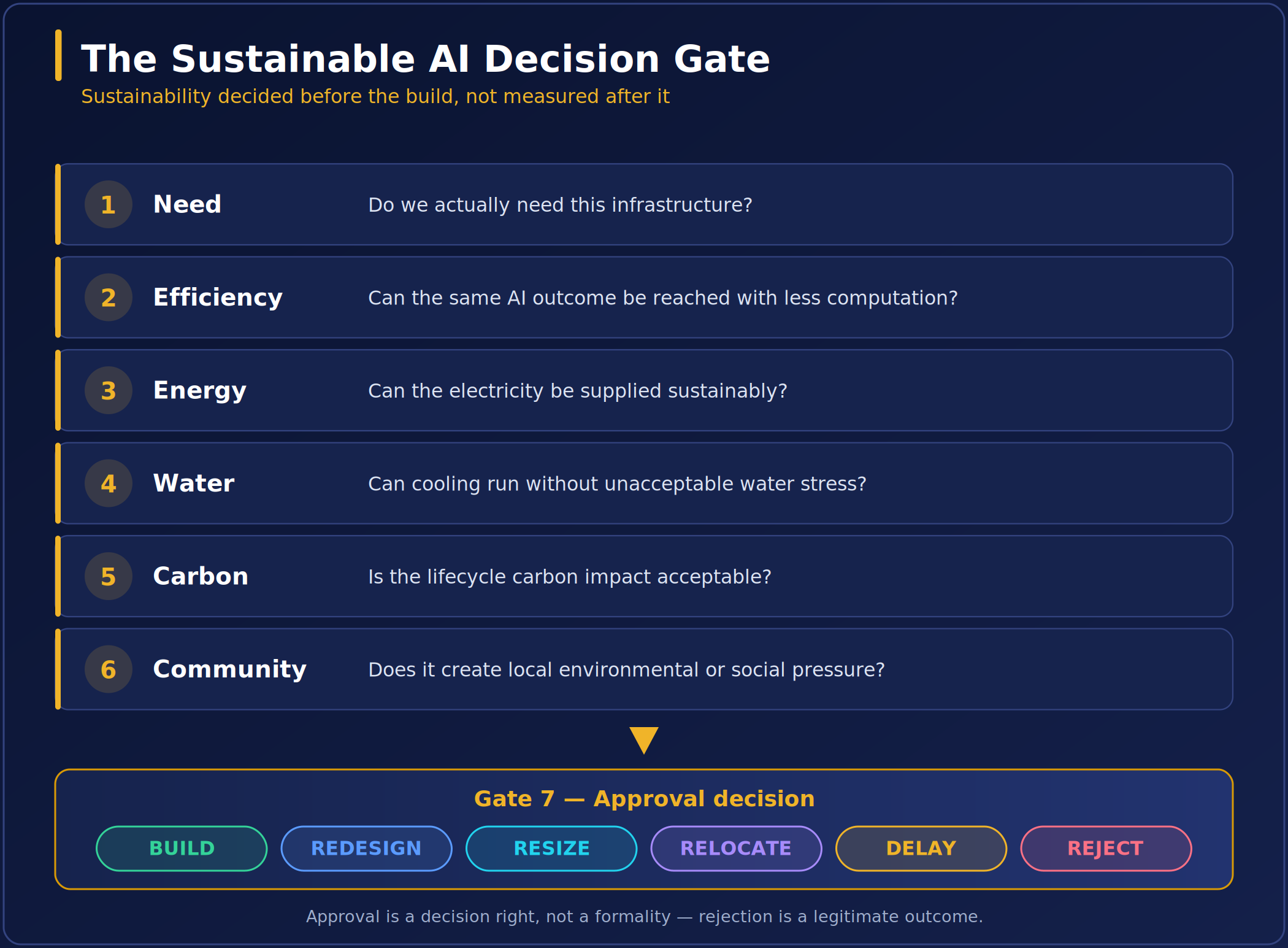
This is a philosophical shift as much as a procedural one. Measurement after commissioning can only describe a facility. A gate before commitment can still change it.
From responsibility to measurable performance
ORSVAI should not stop at names. Each role connects to an indicator, and each indicator is verified by someone who did not produce it. That is what turns a responsibility matrix into a management system.
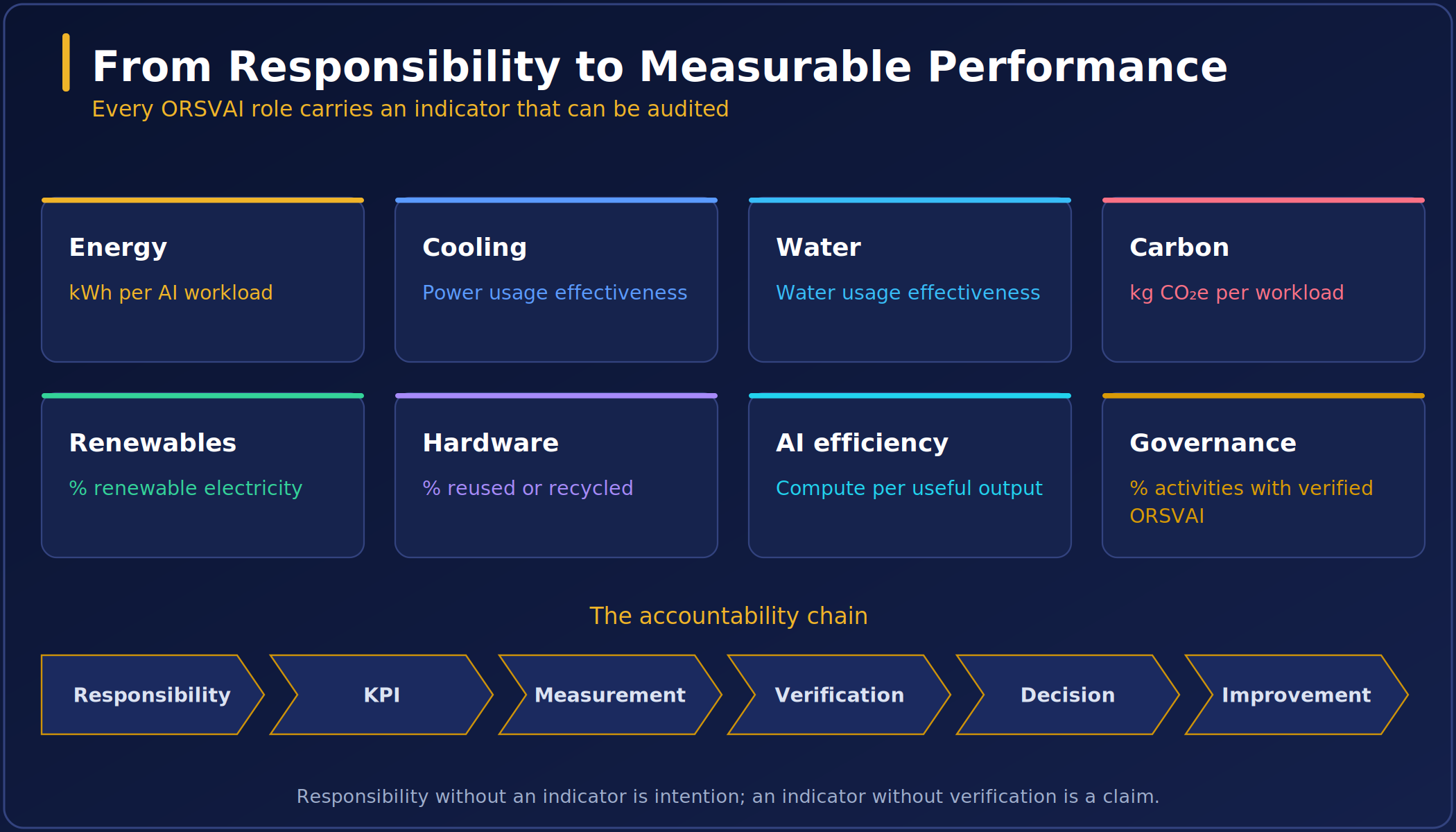
| Sustainability area | Indicator |
|---|---|
| Energy | kWh per AI workload |
| Cooling | Power usage effectiveness (PUE) |
| Water | Water usage effectiveness (WUE) |
| Carbon | kg CO₂e per workload, operational and embodied |
| Renewable energy | % renewable electricity |
| Hardware | % reused, refurbished or recycled |
| AI efficiency | Compute per unit of useful output |
| Governance | % critical activities with a verified ORSVAI assignment |
A question for developing economies
Countries competing to attract data centres, cloud providers and semiconductor investment face a sharper version of this problem. Demand for AI can be unlimited; electricity, water, land, minerals, capital and environmental capacity are not.
The practical questions are specific. How much power can the grid supply? Where should facilities sit? What is the local water position? Which cooling technologies should be permitted? What renewable capacity exists? What happens to obsolete hardware? Who verifies the environmental claims, and who holds authority to stop or redesign a project that fails the test? ORSVAI gives those questions a shared governance language.
The question is no longer how much AI we can build. It is how much AI we can build responsibly within the resources we actually have.
The ORSVAI principle
If an activity has an impact, it must have an Owner.
If someone owns an outcome, someone must be Responsible for execution.
If execution creates risk, it must be Verified.
If the decision carries consequence, it must be Approved.
And if the outcome matters, the right people must be Informed.
From responsible AI to responsible AI infrastructure
AI governance has focused on bias, privacy, security, explainability, safety and human oversight. Those remain essential. But a perfectly governed model running inside an unsustainable facility still leaves a sustainability problem behind it.
So the infrastructure model worth planning for is not compute, data, energy, cooling and network alone. It is compute, energy, water, carbon, hardware — and accountability as a layer of its own, sitting alongside monitoring, reliability and cybersecurity rather than beneath them.
An invitation to test it
ORSVAI should not belong to one company, one industry or one country. It should be tested, challenged, measured and compared against existing governance approaches. Researchers can examine whether it improves accountability. Engineers can apply it to live infrastructure. Sustainability professionals can validate its indicators. Regulators can explore it in AI infrastructure policy. Frameworks earn their place through evidence, not assertion.
The AI revolution is a revolution in infrastructure as much as in intelligence, and every infrastructure revolution eventually becomes a governance challenge. What can AI do is no longer the hardest question. What will AI require, and who answers for it, is.
Owner · Responsible · Support · Verify · Approve · Inform
AI should be powerful enough to transform society, and governed well enough to sustain it.
Suggested citation: Abdulla A. B. (2026). ORSVAI for Sustainable AI Infrastructure: A Responsibility Architecture for the Era of AI. TWA.education.


 TWA
TWA 
Leave a comment